






- Weight is the first decision: midweight (7.5 to 8.4 oz) suits most beginners
- Polymer honeycomb core is the most forgiving and versatile choice for new players
- Fiberglass face gives more power; carbon fiber gives more control and spin
- Grip size matters for comfort and arm health: measure palm-to-ring-finger-tip in inches
- A thicker core (14 to 16mm) produces a larger sweet spot and more forgiveness on off-centre hits
- 1. Why Paddle Choice Matters Even for Beginners
- 2. Paddle Weight: The Most Important Variable
- 3. Core Material: What Is Inside the Paddle
- 4. Core Thickness: Sweet Spot and Forgiveness
- 5. Paddle Face Surface: Fiberglass vs Carbon Fiber vs Graphite
- 6. Grip Size: How to Measure Your Hand
- 7. Handle Length: Control vs Reach
- 8. Paddle Shape: Standard vs Elongated
- 9. Full Comparison Table
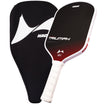
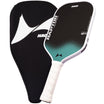
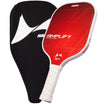
- 10. The Hack Athletics Paddle Range: Which One Suits You
- 11. Related Reading
- 12. Frequently Asked Questions
Walking into a pickleball court with the wrong paddle does not prevent you from playing, but it does slow your development considerably. A paddle that is too heavy causes arm fatigue before you have had enough practice to build consistency. A grip that is too large reduces wrist mobility and increases the risk of elbow strain over time. A core that is too thin makes the sweet spot small and punishing for a beginner who has not yet developed precise ball contact. None of this is immediately obvious when standing in a shop looking at dozens of nearly identical-looking paddles, which is why this guide exists.
The Hack Athletics team has developed three paddle options for the Indian market: the Triumph, Raptor, and Amplify. Understanding the core variables in this guide will tell you exactly which of these paddles, or any other paddle on the market, matches your playing level and goals. This is the framework that makes paddle choice clear rather than overwhelming. For the full rules and court context, see the Hack Athletics pickleball court dimensions and rules guide.
Last reviewed: April 2026
1. Why Paddle Choice Matters Even for Beginners
A common assumption among new pickleball players is that paddle choice only matters once you reach an intermediate or advanced level, and that any entry-level paddle will do for learning. This is partially true but misleading. The specific variables that matter most for beginners (sweet spot size, weight, and grip comfort) are actually more important during the learning phase than later, because a paddle that does not suit your hand and arm will ingrain compensation habits that are difficult to unlearn.
Research from the NCBI on sport-specific equipment and injury prevention in racket sports notes that incorrect grip size is the most consistent predictor of repetitive strain injury (particularly lateral epicondylitis, commonly called tennis elbow) in paddle and racket sports. This finding transfers directly to pickleball: grip size is not a performance preference but a health consideration for anyone playing regularly.
The beginner's priority list: Choose in this order: (1) weight, (2) grip size, (3) core material and thickness, (4) face surface. Most beginners over-prioritise face material and under-prioritise grip size, which is the variable that most directly affects arm health during extended play.
2. Paddle Weight: The Most Important Variable
Paddle weight has the most immediate and noticeable effect on how a paddle feels and performs. Paddles are classified into three weight categories.
Lightweight: Under 7.5 ounces (~210 gms)
Lightweight paddles are highly manoeuvrable and allow very quick hand speed at the net. They require less effort to swing and are gentler on the arm, shoulder, and wrist during extended play. The trade-off is reduced stability: a light paddle can twist in the hand on off-centre hits, and it provides less "plow-through" power when driving the ball from the baseline. Lightweight paddles suit players who prioritise touch, finesse, and fast exchanges at the kitchen rather than power from deep in the court.
Midweight: 7.5 ounces (~210 gms) to 8.4 ounces (~ 240 gms)
Midweight paddles are the most versatile and the standard recommendation for beginners. They provide sufficient stability for off-centre hits while still being manoeuvrable enough for fast net exchanges. The balance of power and control accommodates the varied situations a beginning player encounters before their game style becomes defined. Most quality beginner paddles are designed in the midweight category, and most club players use midweight paddles regardless of experience level.
Heavyweight: 8.5 ounes (~240 gms) and above
Heavy paddles generate the most power and provide the greatest stability on hard-hit balls. They are preferred by players who spend most of their time at the baseline and rely on driving the ball rather than placing it with touch. The significant drawback is arm fatigue: a heavy paddle places considerably more load on the wrist, elbow, and shoulder during extended sessions. Beginners are strongly advised against starting with a heavy paddle until they have developed consistent technique and assessed their natural play style.
If you are unsure between two adjacent weight options, choose the lighter one. You can always add lead tape to a paddle to increase its weight incrementally. Removing weight from a paddle that is too heavy is not possible without affecting the paddle's structure.
3. Core Material: What Is Inside the Paddle
The core is the internal structure of the paddle, sandwiched between the two face surfaces. It is the primary determinant of how the paddle feels, how much vibration it transmits, and how it balances power against control.
Polymer (Polypropylene) Honeycomb Core
Polymer cores are the most widely used in quality pickleball paddles and the correct choice for the vast majority of players. The polypropylene honeycomb structure provides a well-rounded balance of power, control, and touch. It absorbs vibration well, which makes extended play more comfortable on the arm. Polymer cores are also quieter than Nomex alternatives, which is relevant in residential society courts in India where noise considerations matter. For beginners, a thicker polymer core (discussed in Section 4) provides a larger sweet spot and greater forgiveness.
Nomex Honeycomb Core
Nomex is a cardboard-like aramid fibre material that is extremely rigid and produces significant "pop" on ball contact. Nomex cores generate more power than polymer but sacrifice touch and control. They also produce a louder contact sound than polymer, which can be a factor in community settings. Nomex is rarely seen in new beginner paddles today but remains in some legacy and power-oriented models.
Aluminum Honeycomb Core
Aluminum cores are lightweight and produce a soft, controlled feel at the expense of power. They are sometimes found in beginner-level budget paddles. Aluminum cores are durable but the lack of power generation makes them suboptimal for most players beyond the very beginner stage.
4. Core Thickness: Sweet Spot and Forgiveness
Within the polymer core category, core thickness is the variable that most directly affects beginner playability. Core thickness is measured in millimetres, with most paddles falling between 11mm and 20mm.
Thicker Core (14 to 20mm): More Forgiveness
A thicker core absorbs more energy on ball contact and distributes it more evenly across the paddle face. The practical effect is a larger, more consistent sweet spot: a ball hit slightly off-centre behaves more similarly to a ball hit dead-centre. This forgiveness is extremely valuable for beginners who have not yet developed the precise, consistent ball contact that comes from hours of practice. Thicker cores also transmit less vibration, which is more comfortable for extended sessions.
Thinner Core (11 to 13mm): More Power
A thinner core returns more energy to the ball on contact, producing more pace and pop. The sweet spot is smaller and less forgiving, and the feel is crisper and more feedback-rich. Experienced players who have developed consistent technique often prefer thinner cores because the increased power and feedback suit their game. For beginners, a thin core is punishing: off-centre hits feel noticeably different and go unpredictably.
The recommendation for all beginners is to start with a core of 14mm or thicker. As technique improves and ball contact becomes more consistent, moving to a thinner core is a natural progression if more power is desired.
5. Paddle Face Surface: Fiberglass vs Carbon Fiber vs Graphite
The paddle face is the surface that contacts the ball. Face material affects power, control, feel, and spin generation. The three most common materials in quality pickleball paddles are fiberglass, graphite, and carbon fiber.
Fiberglass
Fiberglass is the most flexible of the three face materials. When the ball contacts a fiberglass face, the surface flexes slightly and then springs back, which provides a trampoline-like effect that generates additional power. Fiberglass faces produce the most power of the three standard options and are forgiving on off-centre hits. The trade-off is less precision: the additional flex means less direct control over ball placement. For players who want to drive the ball hard from the baseline, fiberglass is the natural choice.
Graphite
Graphite faces are stiff, light, and provide excellent control and touch. They transmit a clean, consistent feel on ball contact that makes placement shots and dinks at the kitchen highly precise. Graphite generates less inherent power than fiberglass but rewards technical accuracy. Many experienced players and those who prioritise the soft game near the kitchen choose graphite-faced paddles.
Carbon Fiber
Carbon fiber faces are stiffer than graphite and provide the highest level of control combined with significant spin generation. The textured surface of raw carbon fiber paddles grips the ball during contact, allowing players to generate topspin and backspin more easily than with fiberglass or graphite. Carbon fiber has become increasingly popular at the advanced level as spin-heavy game styles have become more prominent. For beginners, the stiffness of carbon fiber can feel less forgiving than fiberglass on power shots.
Beginner recommendation: Composite faces (fiberglass or a fiberglass-graphite blend) are the most forgiving and versatile choice for first-time buyers. They provide enough power to learn serves and groundstrokes effectively while offering adequate control for learning kitchen play. Pure graphite or carbon fiber faces are better suited as an upgrade once technique is established.
Three Paddles. Every Player Level Covered.
Hack Athletics Triumph for beginners seeking control, Raptor for intermediate power players, Amplify for performance at club and competitive level. Plus the Rapid Pro 40-hole outdoor ball.
Shop Pickleball Paddles6. Grip Size: How to Measure Your Hand
Grip size in pickleball is measured as the circumference of the paddle handle, typically ranging from 4 inches to 4.5 inches. Choosing the correct grip size is a health consideration as much as a performance one: an incorrect grip size places additional strain on the forearm muscles and tendons during every shot, which accumulates into repetitive strain over time.
How to Measure
Hold your dominant hand flat with the palm facing upward. Using a ruler or flexible measuring tape, measure from the middle crease of your palm (the second major horizontal crease from the top of the palm) up to the tip of your ring finger. This measurement in inches corresponds to your grip circumference. A measurement of 4 inches or less indicates a small grip, 4 to 4.25 inches a standard grip, and 4.5 inches or above a large grip.
The Verification Test
After gripping a paddle, slide the index finger of your opposite hand into the space between your fingertips and the base of your thumb on the gripping hand. If your finger fits with light pressure, the grip size is correct. If your fingertips are touching your palm (no space), the grip is too small. If you can fit more than one finger in the gap, the grip is too large.
When Between Sizes
If your measurement falls between two standard grip sizes, choose the smaller size and add an overgrip if more thickness is needed. Adding an overgrip increases circumference by approximately one size. You cannot reduce a grip's circumference after purchase, but you can always increase it.
A smaller grip allows more wrist movement and generates more spin, which is an advantage in advanced play. A larger grip provides more stability and reduces wrist action, which can be beneficial for players with existing wrist or elbow issues. When in doubt, start smaller.
7. Handle Length: Control vs Reach
Handle length affects both how the paddle feels in the hand and how much paddle face area is available for ball contact. Handles typically range from 4 inches to 6.25 inches in length.
A shorter handle leaves more material for the paddle face, which means a larger hitting surface and sweet spot. This suits players who play close to the kitchen and prioritise the short game: dinks, drops, and precise placement. Shorter handles also suit players with a table tennis background who use a pistol-style grip with extensive wrist action.
A longer handle provides more leverage for groundstrokes and enables two-handed backhand shots (common for former tennis players). The extended reach is also useful for defending wide balls from the baseline. The trade-off is a slightly reduced paddle face area. Players from a tennis or badminton background often find longer handles more natural initially.
8. Paddle Shape: Standard vs Elongated
Paddle shape refers to the overall dimensions of the paddle face and handle combined. Standard (traditional) paddles are wider at the face and have a shorter handle, maximising sweet spot area. Elongated paddles are narrower at the face and have a longer handle, maximising reach and leverage.
For beginners, a standard or slightly widebody paddle shape is the better starting point. The larger sweet spot reduces the punishment for slightly off-centre contact, which is extremely common when learning the game. Elongated paddles reward precision that most beginners have not yet developed. According to guidance from the USA Pickleball official resources on equipment, combined paddle length and width cannot exceed 24 inches in competition, with paddle length alone limited to 17 inches maximum.
9. Full Comparison Table
| Variable | Beginner Choice | Intermediate Choice | Advanced Choice |
|---|---|---|---|
| Weight | Midweight (7.5 to 8.4 oz) | Midweight or light (7.0 to 8.4 oz) | Any, based on play style |
| Core material | Polymer honeycomb | Polymer honeycomb | Polymer or proprietary foam blend |
| Core thickness | 14mm to 16mm (thick) | 13mm to 16mm | 11mm to 16mm, play style dependent |
| Face surface | Fiberglass or composite | Graphite, fiberglass, composite, carbon fibre, Carbon fibre and Fibreglass blend | Carbon fiber or graphite |
| Grip size | Match to hand measurement | Match to hand or slightly smaller | Smaller for more wrist action |
| Handle length | Standard (4.5 to 5.5 in) | Standard or long (5 to 6 in) | Long if 2-hand backhand used |
| Paddle shape | Standard or widebody | Standard or elongated | Elongated for reach and spin |
| Priority outcome | Forgiveness and comfort | Balance of power and control | Spin, precision, and power optimised for style |
10. The Hack Athletics Paddle Range: Which One Suits You
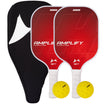
Hack Athletics offers three paddles and a combination set designed to cover the range of Indian pickleball players from first-session beginners through to regular club competitors.
- Designed for players seeking maximum power with control
- 16mm thermoformed core for explosive drives
- Raw carbon fiber surface for enhanced spin & consistency
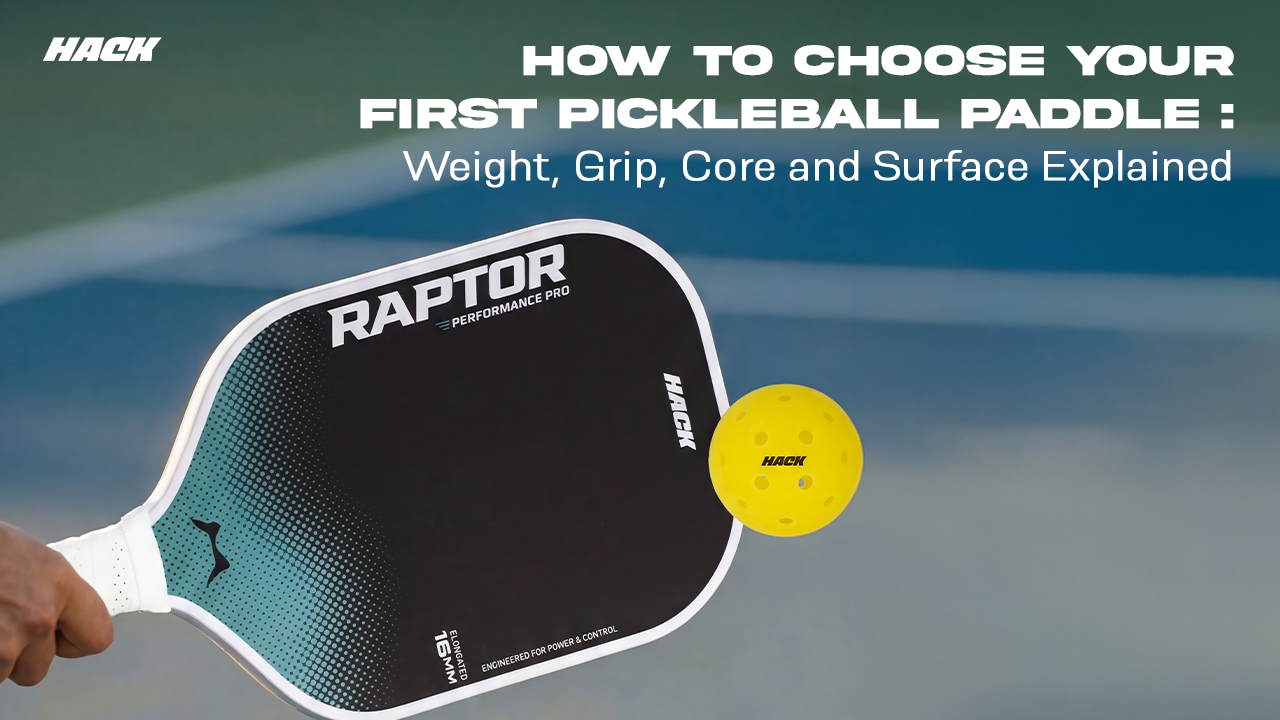
- Elongated shape + extended handle for better reach & leverage
- Large sweet spot to reduce mishits in fast rallies
- Built for confident, aggressive play at every level
- 16mm core + raw carbon fiber surface for control, spin, and precision
- Quick maneuverability for fast-paced rallies
- Elongated shape + extended handle for better reach & leverage
- Thermoformed construction for a solid, stable feel on impact
- Built for confident, high-performance play
- Designed for beginners to intermediate players
- Fiberglass face + polymer honeycomb core for balanced power, spin & control
- Lightweight design for easy handling
- Large sweet spot for consistent shots
- Comfort grip for a secure, fatigue-free hold during long games
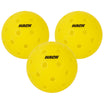
- Rapid Pro 40-Hole Outdoor Pickleball Balls — approved for outdoor court play
- Stainless Steel Shaker Bottle — cold hydration for outdoor summer sessions
- All Hack Athletics Products
- Choose midweight (7.5 to 8.4 oz) for your first paddle: it provides the most forgiving balance of power and control
- Polymer honeycomb core with 14 to 16mm thickness gives the largest sweet spot for beginners
- Fiberglass or composite face suits most beginners; carbon fiber and graphite are better upgrades once technique is established
- Measure your grip size: palm middle crease to ring finger tip in inches; choose smaller if between sizes
- Standard or widebody paddle shapes are more forgiving than elongated models for new players
- Grip size is the variable most directly linked to arm health over extended play — do not guess it
11. Related Reading
- Weightlifting Belts
- Wrist Wraps — useful for players with wrist strain from extensive paddle use
- Knee Sleeves — for players managing knee comfort on hard court surfaces
- Stainless Steel Shaker Bottles
12. Frequently Asked Questions
What weight pickleball paddle should a beginner choose?
Beginners should start with a midweight paddle in the 7.5 to 8.4 ounce range. Midweight paddles provide a balance of control and power that suits the learning phase of pickleball. Lightweight paddles (under 7.5 oz) are very manoeuvrable but can feel unstable on off-centre hits. Heavyweight paddles (above 8.5 oz) offer power but can cause arm fatigue and reduce reaction speed near the kitchen.
What is the best core material for a beginner pickleball paddle?
Polymer (polypropylene) honeycomb core is the best choice for beginners. It provides a good balance of power, control, and touch, produces less vibration than Nomex or aluminum alternatives, and is more comfortable during extended sessions. A thicker polymer core (14 to 16mm) increases the sweet spot and forgiveness, making it ideal for players still developing consistent ball contact.
How do I measure my grip size for a pickleball paddle?
Hold your dominant hand flat with the palm facing upward. Measure from the middle crease of your palm (the second major crease from the top of the palm) to the tip of your ring finger. This measurement in inches corresponds to your grip size: 4 inches or smaller is a small grip, 4 to 4.25 inches is a standard grip, and 4.5 inches or larger is a large grip. If between sizes, choose the smaller option and add an overgrip if more thickness is needed.
What is the difference between a fiberglass and carbon fiber paddle face?
A fiberglass paddle face is more flexible and provides more power by generating a spring-like effect when the ball makes contact. It is the better choice for players who want more pace on their shots. A carbon fiber face is stiffer and provides more control and precision at the expense of raw power. Carbon fiber also generates more spin due to its textured surface. For beginners, fiberglass or composite faces are generally more forgiving and easier to learn with.
What are the official size limits for a pickleball paddle?
USA Pickleball rules specify that the combined length and width of a pickleball paddle cannot exceed 24 inches (60.96 cm), and the paddle length alone cannot exceed 17 inches (43.18 cm). The paddle must be made of rigid, non-compressible material, and the surface must be smooth without holes, cracks, rough textures, or delamination. All paddles used in sanctioned tournaments must appear on the official USA Pickleball approved paddle list.
Can I use a tennis racquet or badminton racquet for pickleball?
No. Pickleball rules require a solid paddle, not a strung racquet. Tennis racquets and badminton racquets are not permitted in pickleball. A pickleball paddle's solid face is what creates the controlled, consistent ball contact that defines the sport. Using a strung racquet would fundamentally change the ball's trajectory and spin in ways that are incompatible with the game's rules and intended play characteristics.
How long does a pickleball paddle last?
Should I choose a longer or shorter handle for my first paddle?
For most beginners, a standard handle length of 4.5 to 5.5 inches is the most practical starting point. Longer handles provide more leverage for two-handed backhands and baseline groundstrokes, which is an advantage for former tennis players. Shorter handles give more room on the paddle face (larger sweet spot) and suit players who prefer quick wrist action near the kitchen. If you come from a table tennis background, a shorter handle may feel more natural.