



Key Highlights
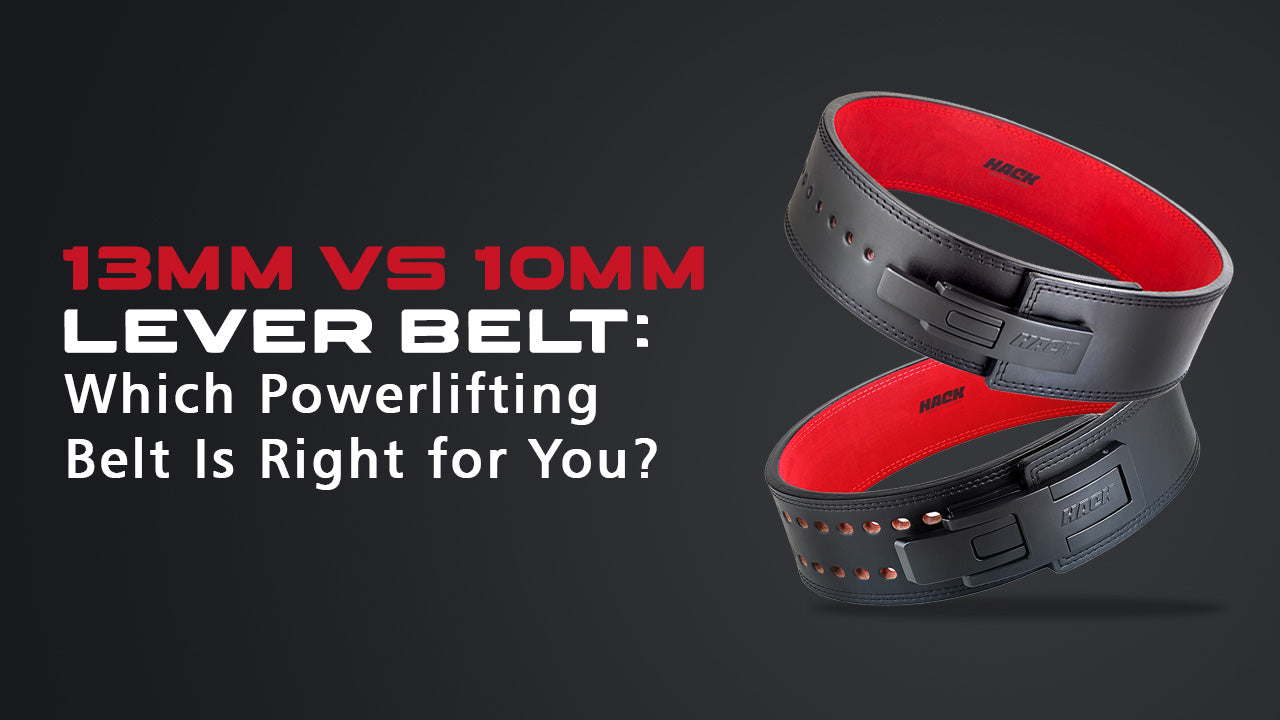
- A 13mm lever belt is noticeably stiffer than a 10mm belt, providing a more rigid brace for maximal powerlifting efforts.
- A 10mm lever belt breaks in faster (4 to 6 weeks versus 2 to 3 months) and suits a wider range of training styles.
- Both 13mm and 10mm Hack Athletics lever belts are built to meet most IPF dimension standards -- the same physical specifications used in competitive powerlifting.
- Serious powerlifters and those chasing maximum squat and deadlift performance in training should favour the 13mm.
- Beginners, bodybuilders, and general strength athletes typically get more value from the 10mm for daily training.
- Hack Athletics manufactures both belt thicknesses to meet most IPF dimension specifications using precision handcrafted construction.
Every serious lifter arrives at the same crossroads eventually: you have decided to invest in a proper lever belt, and now you are staring at two thickness options -- 13mm or 10mm -- wondering which one is actually right for you. The difference in numbers sounds small, but the practical difference in rigidity, comfort, and purpose is significant enough to matter. Whether you are browsing the full weightlifting belt range or narrowing down your first serious training belt, this guide will give you everything you need to make a confident, informed choice.
At Hack Athletics, we build every lever belt to meet most International Powerlifting Federation (IPF) dimension specifications. Our team has tested both thicknesses across hundreds of training sessions and heavy lifts, and we have worked with lifters ranging from first-time gym-goers to national-level powerlifters. That hands-on experience shapes every recommendation in this article.
By the time you finish reading, you will understand exactly what changes between a 13mm and a 10mm belt, which thickness suits your current training level and goals, how each belt is built in line with federation dimension standards, and how to size, break in, and care for your belt for the long term. Let us get into it.
Last reviewed: July 2025
1. Understanding Belt Thickness in Powerlifting
Belt thickness is measured in millimetres through the full cross-section of the belt material. When manufacturers state a belt is 13mm thick, they mean the compressed body of the belt -- excluding any lining or surface coatings -- measures 13 millimetres from face to face. A 10mm belt measures 10 millimetres by the same standard.
That 3mm difference translates directly into stiffness. Leather behaves somewhat like a spring: a thicker cross-section resists bending more strongly. When you brace hard against a 13mm belt during a heavy squat, the belt provides a firmer wall of resistance than a 10mm belt under identical bracing force. The result is higher potential intra-abdominal pressure (IAP) at the same level of muscular effort.
Intra-abdominal pressure is the mechanism through which a lifting belt actually works. When you take a deep diaphragmatic breath and bear down against a closed belt, pressure builds inside the abdominal cavity. That pressurised column of air stiffens the spine from the inside, reducing compressive and shear forces on the lumbar vertebrae during heavy loading. A stiffer belt provides a harder surface to press against, enabling greater IAP for the same breath. Research published through sources such as the National Library of Medicine has examined how lifting belts affect spinal loading and IAP during maximal efforts, and the consensus supports belt use for heavy compound lifts where spinal load is high.
Understanding thickness helps you match your belt to your training demands. A 13mm belt makes sense when every kilogram of IAP is critical to your performance. A 10mm belt is a capable daily driver that serves the vast majority of lifters extremely well. Browse the Hack Athletics weightlifting belt collection to see both options side by side.
2. How a Lever Belt Works
A lever belt uses a hinged steel mechanism to fasten the belt at a fixed, consistent tightness every session. Unlike a prong belt -- where you thread the prong through a hole each time -- a lever belt snaps shut at the same position every time you close it. This repeatability is one of its most practical advantages for serious lifters who need their belt in exactly the same position set after set.
The lever consists of a fixed plate attached to one end of the belt and a hinged arm that swings over and locks under a lip on the opposite end. Closing the lever requires firm downward pressure -- once locked, it will not open under the forces generated during a maximal squat or deadlift. Opening requires flipping the lever arm upward with your fingers or a thumb, which releases instantly.
The lever position can be adjusted using a small flathead screwdriver. You unscrew two small bolts, slide the lever plate to a new hole position, and re-tighten. This means you can dial in exact tightness for each lift -- some lifters set their lever one position tighter for squats and loosen it slightly for deadlifts, requiring a 30-second adjustment between movements.
Also read: Shop the full Hack Athletics weightlifting belt range
3. 13mm vs 10mm: Side-by-Side Comparison
The table below distils the key differences between 13mm and 10mm lever belts. Both options from Hack Athletics share the same material quality, stitching, and lever engineering -- the thickness is the variable.
| Feature | 13mm Lever Belt | 10mm Lever Belt |
|---|---|---|
| Thickness | 13mm | 10mm |
| Stiffness | Maximum rigidity | Moderate -- more flexible |
| Break-in Period | 2 to 3 months | 4 to 6 weeks |
| Weight | ~2,500g | ~1,500g |
| Best For | Heavy powerlifting training, maximal squats and deadlifts | General strength training, bodybuilding, beginners, daily use |
| Built to IPF Dimension Standards | Yes | Yes |
| Closure Type | Matt Black Metal Lever (adjustable) | Matt Black Metal Lever (adjustable) |
| Hack Athletics Option | 13mm Carbon Fibre, 13mm Carbon Fibre 2-Claw, 13mm Signature Red | 10mm Carbon Fibre, 10mm Signature Red, 10mm Signature Green |
Also read: Hack Athletics Premium 13mm Carbon Fibre Lever Belt -- full product details and sizing
4. Who Should Choose the 13mm Belt
The 13mm lever belt is purpose-built for one thing: maximum performance during heavy training blocks and the high-intensity work that serious powerlifters do most. If your primary goal is to squat, bench, or pull the most weight possible in training, the 13mm is the belt designed for that task.
Serious Powerlifting Training
When powerlifters are deep in a heavy training cycle, they want a belt that mirrors the physical feel of the most demanding equipment available. Using a 13mm belt in training means choosing the maximum rigidity available within standard powerlifting dimensions. For lifters who have spent months breaking in their belt and training to brace optimally against it, the payoff in the gym is real. We have seen athletes add meaningful kilograms to their training personal bests simply by upgrading from a 10mm to a 13mm belt and taking the time to adapt to its feel.
One scenario we see repeatedly: a lifter has been training on a 10mm for their first year, building a strong foundation and preparing to enter their first meet. They switch to a 13mm belt eight weeks out and find the first few sessions uncomfortable -- the belt digs in, feels restrictive on the descent of the squat, and creates unfamiliar pressure. By the time competition day arrives, however, the belt has moulded enough to feel like an extension of their body, and their training squats are noticeably more stable than anything they hit with the thinner belt. (Note: for the actual meet, lifters will need to use a federation-approved belt -- but training in a 13mm built to those same dimension standards is the ideal preparation.)
Maximum Squat and Deadlift Performance in Training
Even outside of formal competition preparation, lifters chasing personal bests at heavy percentages (90 percent of maximum and above) will notice the additional bracing surface a 13mm belt provides. At these intensities, every marginal gain in stability matters. The stiffer brace also acts as a proprioceptive cue -- your body receives stronger feedback about core position, which can improve technique consistency at near-maximal loads.
View the 13mm Carbon Fibre Lever Belt or the 13mm standard lever belt in the Hack Athletics product range.
5. Who Should Choose the 10mm Belt
The 10mm lever belt is far from a compromise. For the majority of lifters -- including many serious powerlifters -- it is the better belt for the training they actually do most of the time. It provides excellent intra-abdominal pressure support, meets most IPF dimension specifications, and offers a training experience that is comfortable from week one rather than month three.
General Strength Training
If your weekly programme includes a variety of compound movements, accessory lifts, and moderate-to-high rep work, a 10mm belt is significantly more versatile. The slight flexibility of a 10mm belt allows a more natural range of motion during exercises like Romanian deadlifts, good mornings, and barbell rows -- movements where a fully rigid 13mm can feel unnecessarily restrictive. Bodybuilders and strength athletes who are not specifically preparing for powerlifting competition will find the 10mm a better daily companion.
Faster Break-In and Daily Training Use
New lifters often underestimate how physically demanding a stiff belt can be when it has not yet broken in. A brand-new 13mm belt in the first few weeks of use can be genuinely uncomfortable -- it resists bending around the torso, creates uneven pressure, and may leave marks. A 10mm belt, by contrast, begins to conform to your body shape within the first few training sessions. For a beginner who is learning to brace properly, the 10mm removes one point of friction and lets you focus on technique.
Find Your Perfect Powerlifting Belt
IPF-standard 13mm and 10mm lever belts built for serious lifters. Shop the full Hack Athletics belt range and find the thickness, style, and size that matches your training goals.
Shop Weightlifting BeltsExplore the 10mm Signature Red Lever Belt, the 10mm Signature Green Lever Belt, or the 10mm standard weightlifting lever belt in the Hack Athletics range.
6. Belt Thickness and Federation Rules
Before you commit to a belt, it is worth understanding what federation rules actually require -- both in terms of dimensions and brand approval -- so you can make the right purchasing decision for your training and competition needs.
The International Powerlifting Federation (IPF) Technical Rules specify that a lifting belt must be worn on the outside of the lifting suit and must not exceed 10cm in width or 13mm in thickness. Both single-prong and lever closures are permitted. The belt must be a single, unmodified layer of leather or similar material. Full IPF technical regulations are published at powerlifting.sport and updated periodically.
The USAPL (USA Powerlifting), which is the IPF affiliate in the United States, adopts the same equipment standards. Detailed equipment specifications are available at usapowerlifting.com.
All Hack Athletics lever belts are manufactured to meet most IPF dimension specifications. You can read more about how we approach this standard on the Hack Athletics About Us page.
7. The Break-In Period: What to Expect
Every new lifting belt requires a break-in period before it feels truly comfortable and reaches its performance potential. The thickness of the belt has a direct effect on how long this process takes and how demanding it feels. Understanding what to expect prevents new belt owners from assuming there is something wrong with their purchase.
A new 13mm lever belt typically requires 2 to 3 months of regular use before it fully conforms to your body shape. In the first few weeks, the belt will feel stiff and may dig into your hips and lower ribs during squats and deadlifts. This is completely normal. The material is dense and resistant to bending; it needs repeated loading and flexing cycles to relax and mould to your proportions.
A new 10mm lever belt has a shorter break-in arc -- typically 4 to 6 weeks for most lifters training three or more sessions per week. The thinner construction bends more readily and adapts to your body faster.
How to Speed Up Break-In Safely
Several techniques can accelerate the break-in process without damaging the belt. Before training sessions, roll the belt firmly back and forth in your hands, bending it at the natural flex points (across the lumbar region and at the front). This applies mechanical stress in the same planes the belt will flex during use. You can also gradually increase tightness over successive sessions rather than cranking it to maximum from day one -- this allows the material to soften and conform progressively rather than all at once.
Signs Your Belt Has Broken In Correctly
A fully broken-in belt feels like a firm but comfortable extension of your torso when worn at training tightness. It closes smoothly with the lever and does not create hotspots or sharp pressure points. The surface may show slight creasing at the natural flex points -- this is normal wear and a sign the belt is conforming correctly. If you hear creaking sounds early in a session that diminish as the material warms up, that too is a normal characteristic of a quality belt under repeated loading.
Also read: Hack Athletics 13mm Signature Red Lever Belt -- product details, sizing, and care instructions
8. How to Size and Fit Your Lever Belt
Correct sizing is critical to both comfort and performance. A belt that is too large will not generate adequate pressure even when closed. A belt that is too small may feel restrictive at rest and potentially uncomfortable during extended training. The most common mistake people make when sizing a lifting belt is measuring their waist or using their trouser size -- these are the wrong measurement points.
Where to Position the Belt on Your Body
A powerlifting lever belt should sit directly below your rib cage and above your hip bones. This is the natural zone of the lumbar spine where intra-abdominal pressure is most effective at stabilising the vertebrae during squats and deadlifts. Wearing the belt too high (above the rib cage) reduces its effectiveness and can impair breathing. Wearing it too low (on the hip bones) similarly reduces bracing effectiveness and can cause the belt to shift during heavy lifts.
Adjusting the Lever for the Right Tightness
The lever position is set by moving the lever plate along a series of holes drilled into the belt. Start with the lever in the middle of the available range. Close the belt while standing upright and wearing the clothing you normally train in. It should require genuine effort to close and feel snug. Then take a full diaphragmatic breath and brace hard -- the belt should feel tight and supportive without cutting off circulation or preventing you from breathing at all. If you can close the lever while fully exhaled, tighten by one hole position.
Sizing charts are available on individual product pages for both the 13mm lever belt and 10mm lever belt in the Hack Athletics range.
9. Caring for and Maintaining Your Belt
A quality powerlifting belt is a long-term investment. With proper care, it will outlast most other pieces of equipment you own and continue performing at its best for years. Neglecting basic maintenance, however, can lead to premature wear, lever corrosion, and a dramatically shortened lifespan.
After every training session, allow the belt to air out completely if it has absorbed sweat. Lay it flat or hang it over a rail in a well-ventilated space. Never pack a damp belt straight into a bag or locker -- trapped moisture accelerates deterioration and can cause unpleasant odours. Keep the belt away from direct sunlight during storage, as prolonged UV exposure can fade colouring and weaken the material over time.
To keep the belt surface clean, wipe it down with a damp cloth after sessions and allow it to dry naturally. Avoid harsh solvents or chemical cleaners. A mild wipe-down is all that is typically needed to remove chalk, sweat, and general gym grime from the outer surface. For the suede inner lining, a soft brush or dry cloth works well to keep the non-slip surface in good condition.
For the lever mechanism, keep the hinge and locking surfaces free from chalk residue. A brief wipe after sessions and a light application of machine oil to the hinge point two or three times per year will keep the lever operating smoothly. The lever itself is covered by a separate warranty period with Hack Athletics -- check the product page for current terms.
Also read: Hack Athletics 7mm Leather Prong Belt -- an alternative for versatile training
10. Who Uses Each Belt?
Different athletes have different priorities. Below we have grouped the most common lifter profiles and mapped each to the belt thickness and supporting gear most suited to their needs.
Competitive Powerlifters (Training Use)
Athletes competing in IPF, USAPL, or similar federations at regional, national, or international level. For this group, the 13mm lever belt -- built to meet most IPF dimension standards -- is an ideal training tool for preparing with competition-spec equipment. Remember to use a federation-approved belt on the competition platform itself.
Strength Athletes and Bodybuilders
Lifters focused on progressive overload, hypertrophy, and general strength gains outside of competition. The 10mm provides daily training support without the extended break-in of the 13mm.
Recreational Gym-Goers
Lifters who train for health, general fitness, and personal bests without formal competition. The 7mm prong belt or 10mm lever belt both work well here. The prong offers simpler sizing flexibility; the lever offers faster on/off.
Full Lifting Setup
A belt is the foundation, but a complete powerlifting or strength kit includes knee support, wrist protection, and reliable lifting straps for pulling work. Explore the supporting accessories below.
Key Takeaways
- The 13mm lever belt provides maximum rigidity and is the preferred training choice for serious powerlifters who want to prepare with competition-dimension equipment.
- The 10mm lever belt is more versatile, breaks in faster, and suits the majority of lifters for daily training -- including intermediate and advanced strength athletes.
- Both thicknesses are built to meet most IPF dimension standards. Choosing 13mm does not mean the 10mm is substandard -- it means your training demands have outgrown it.
- Break-in time matters: allow 2 to 3 months for a 13mm and 4 to 6 weeks for a 10mm before your belt feels fully comfortable.
- Correct sizing is measured at the belly button with training clothes on -- never use your pant or trouser size.
- Routine belt care (wiping down after sessions, airing out, keeping the lever free of chalk) can extend the useful life of your belt to a decade or more.
- If you are preparing for your first competition, train with a Hack Athletics belt to get comfortable with competition-dimension gear -- and confirm your federation's approved equipment list for what you will need to wear on the platform.
11. Related Reading
Belt Products
Collections
About Hack Athletics
12. Frequently Asked Questions
Are Hack Athletics belts built to meet most IPF dimension standards?
Yes. Hack Athletics lever belts are manufactured to meet most IPF dimension specifications -- up to 13mm in thickness and up to 10cm (approximately 4 inches) in width. This makes them an excellent training tool for powerlifters who want to practise with equipment built to closely match the physical standards of competition gear. However, IPF-sanctioned competitions require the use of belts from an officially approved brand list. Always check your federation's current approved equipment list before competing.
What is the difference between a 13mm and 10mm lever belt?
The primary difference is thickness and the resulting stiffness. A 13mm belt is 30 percent thicker than a 10mm belt, which translates to a noticeably more rigid brace. The 13mm provides more intra-abdominal pressure support during maximal lifts such as heavy squats and deadlifts, but requires a longer break-in period of roughly 2 to 3 months. The 10mm is more flexible, breaks in faster (around 4 to 6 weeks), and suits a wider range of training styles including general strength work and bodybuilding.
Which belt is better for beginners?
For most beginners, the 10mm lever belt is the more practical starting point. It breaks in faster, allows a greater range of motion during initial skill development, and works well for all major compound lifts. Once a lifter has built a solid foundation and begins training with near-maximal loads or preparing for competition, upgrading to a 13mm becomes worthwhile.
How long does a 13mm belt take to break in?
A new 13mm belt typically requires 2 to 3 months of regular training before it fully conforms to your body. In the first few weeks it will feel stiff and may leave pressure marks. You can accelerate the process by gently rolling the belt back and forth in your hands before training sessions, and by gradually increasing tightness over successive sessions rather than cranking it to maximum on day one.
Can I use a 13mm belt for bodybuilding or general gym training?
You can, but it is generally not the most comfortable choice for high-rep, general gym work. The stiffness of a 13mm belt can feel restrictive during exercises that require more torso mobility, such as Romanian deadlifts, rows, and accessory movements. A 10mm lever belt or the 7mm prong belt offers more versatility for bodybuilding-style training while still delivering meaningful back support.
How do I measure my belt size?
Do not use your pant size or waist measurement. With your training clothes on, wrap a flexible measuring tape around your midsection at the level of your belly button. That measurement in centimetres or inches is your belt sizing reference. Use the sizing chart on each Hack Athletics product page to find your correct size. Hack Athletics belts include a buffer of adjustment on both sides of the buckle position, so you have room to accommodate body composition changes.
What does IPF-standard mean for Hack Athletics belts?
IPF-standard refers to the physical construction specifications set by the International Powerlifting Federation -- 13mm maximum thickness, 10cm maximum width, single-piece construction, and a lever or single-prong closure. Hack Athletics belts are manufactured to meet most of these dimensional and construction standards, making them an excellent training tool for powerlifters who want to practise with equipment that closely mirrors competition specifications. For actual IPF-sanctioned competition, lifters must use a belt from the federation's approved equipment list. You can read more about the brand's commitment to this standard on the About Us page.
Can I adjust a lever belt without tools?
The lever position on a lever belt is set using a small screwdriver during initial fitting, but you do not need tools to open or close the belt during training. Once set, the lever flips open with a single movement and snaps shut with firm pressure. If you need to adjust the tightness between sessions -- for example after a weight change -- a small flathead screwdriver is required to reposition the lever plate. This is typically a two-minute process and only needs to be done occasionally.
Which belt should I buy if I am preparing for my first powerlifting meet?
If you are preparing for your first meet, the most important step is to check your federation's approved equipment list -- most sanctioned federations require belts from specific approved brands on the competition platform. For training in the lead-up to your meet, a Hack Athletics 13mm lever belt -- built to meet most IPF dimension standards -- is an excellent way to get comfortable bracing and training with competition-spec equipment. The 13mm offers maximum rigidity for your heaviest training work, while the 10mm breaks in faster and suits a wider range of training. Either way, build your technique and confidence in training, and have your approved competition belt ready for meet day.
How do I care for my powerlifting belt?
After training, allow the belt to air out completely -- lay it flat or hang it in a well-ventilated space. Never pack a damp belt into a bag or locker, as trapped moisture accelerates deterioration. Keep the belt away from direct sunlight during storage. Wipe the outer surface down with a damp cloth after sessions and allow it to dry naturally. For the suede inner lining, a soft brush or dry cloth keeps the non-slip surface in good condition. Keep the lever mechanism free from chalk buildup and apply a light oil to the hinge point a few times per year. With proper care, a quality powerlifting belt can last many years of hard training.