






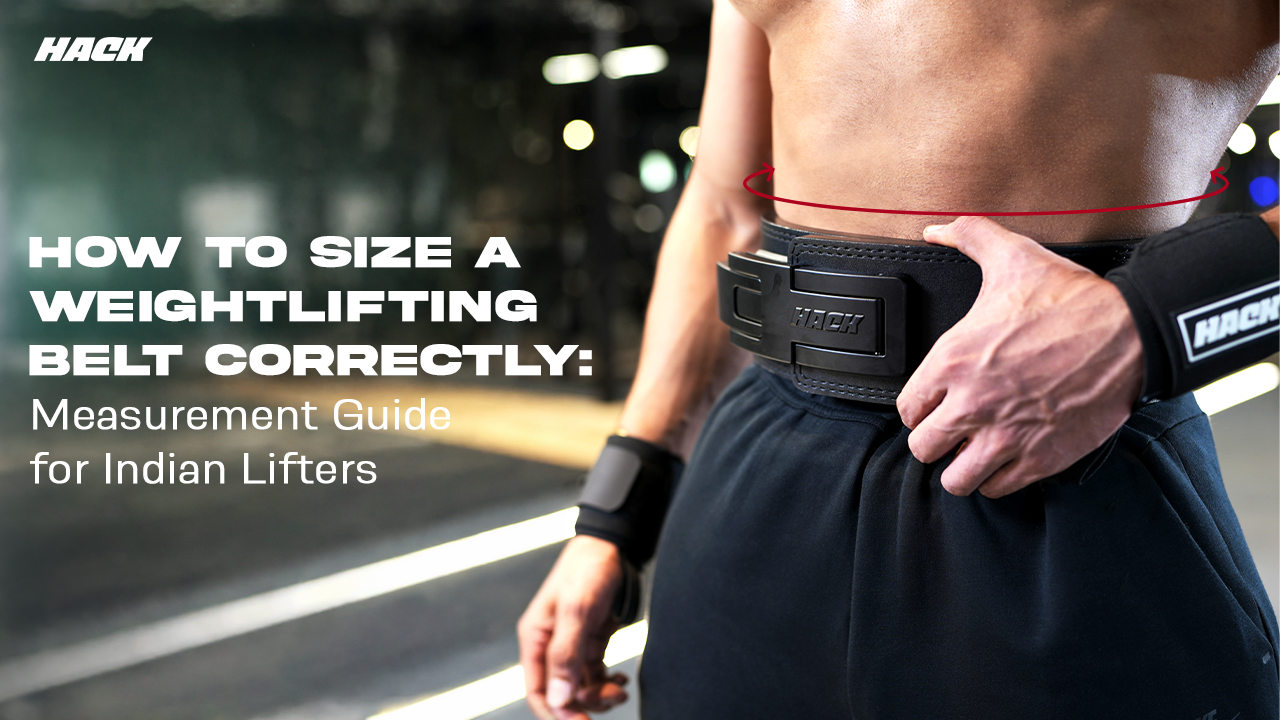
- Always measure at the belly button with clothes on, never use pant or waist size
- If you fall between two sizes, always size down for a secure, supportive fit
- Belt thickness (7mm, 10mm, 13mm) does not change your measurement method
- A properly fitted belt should allow a full belly breath while feeling firmly engaged
- Hack Athletics belts include a one-inch buffer on both ends to accommodate body changes
- Lever belts and prong belts use the same measurement method but have separate size charts
- 1. Why Belt Sizing Matters More Than You Think
- 2. The Only Correct Way to Measure for a Belt
- 3. Belt Types and Their Sizing Differences
- 4. How to Read a Belt Size Chart
- 5. Common Sizing Mistakes Indian Lifters Make
- 6. How Tight Should Your Belt Actually Be?
- 7. Sizing for Belt Thickness: 7mm vs 10mm vs 13mm
- 8. Breaking In a New Belt After Sizing
- 9. Expert Tips for Long-Term Belt Fit
- 10. Who Needs Which Belt Type
- 11. Related Reading
- 12. Frequently Asked Questions
Getting the right belt size is the single most important decision you will make before buying a weightlifting belt. A belt that is too large slides around during heavy squats and deadlifts, providing little meaningful intra-abdominal pressure. A belt that is too small cuts into the ribs or hip bones, making it impossible to breathe correctly under load. Both problems are entirely avoidable with one accurate measurement. At Hack Athletics' weightlifting belt collection, every product includes a size chart based on belly button circumference because this is the only measurement that genuinely reflects how a belt will sit on your torso during a lift.
Indian lifters face a specific challenge: garment sizes on the subcontinent have almost no standardisation. A size 34 trouser from one brand can correspond to a completely different waist circumference than the same number from another. Using your pant size to order a lifting belt is a reliable way to end up with the wrong size. The team at Hack Athletics, built by athletes who train and compete in India, developed this guide to remove the guesswork entirely.
Last reviewed: April 2026
1. Why Belt Sizing Matters More Than You Think
A lifting belt works through a mechanism called intra-abdominal pressure (IAP). When you brace your core and take a diaphragmatic breath against a rigid belt, pressure builds uniformly inside your abdominal cavity. This pressure acts like an internal pillar, stabilising the lumbar spine against compressive and shear forces that occur during heavy squats and deadlifts. Research published in the Journal of Applied Physiology demonstrated that wearing a lifting belt increases intra-abdominal pressure significantly, which reduces the erector spinae muscle activation needed to maintain an upright spine position under load.
For IAP to work, the belt must fit the right part of the torso. A belt worn too low sits across the hip bones rather than the soft tissue of the mid-section, which prevents the abdominal wall from pressing outward into the belt on inhalation. A belt worn too high presses against the lower ribs, restricting the breathing mechanics needed to create IAP in the first place. Correct sizing ensures the belt can be worn in the correct anatomical position on every single lift.
Key figure: Studies on intra-abdominal pressure suggest a properly worn lifting belt can increase IAP by 15 to 40 percent during heavy compound lifts, depending on individual bracing technique and belt stiffness.
2. The Only Correct Way to Measure for a Belt
What You Need
You need a flexible fabric or plastic measuring tape. A rigid steel tape measure will not conform to the curve of your torso and will give an inaccurate reading. If you do not have a flexible tape measure, use a piece of non-stretchy string and measure the string against a ruler.
The Step-by-Step Measurement Process
Stand naturally with your feet shoulder-width apart. Do not suck in your stomach or puff it out. Wear your regular training clothes including a t-shirt, because you will be wearing the belt over your shirt in the gym. Find your belly button and place the measuring tape directly around your torso at this level. The tape should be parallel to the floor on all sides. Pull the tape snug but not tight enough to compress the tissue. Read the measurement in centimetres or inches while breathing normally. Take the measurement twice and use the larger of the two readings.
Always measure with your clothes on, as you would wear the belt in training. Measuring against bare skin gives a smaller number than your actual belt position in the gym and can cause you to order one size too small.
3. Belt Types and Their Sizing Differences
Hack Athletics offers several distinct belt types, and understanding which type matches your lifting goals helps narrow down the right product before you even look at a size chart.
| Belt Type | Thickness | Closure | Best For | Sizing Note |
|---|---|---|---|---|
| 13mm Lever Belt | 13mm | Metal lever | Competitive powerlifting, max effort lifts | Measure belly button; size down if between sizes |
| 10mm Lever Belt | 10mm | Metal lever | Powerlifting, strength training | Measure belly button; size down if between sizes |
| 7mm Prong Belt | 7mm | Single prong | General strength training, beginner to intermediate | Measure belly button; prong belts allow more adjustment |
| Quick-Lock Nylon Belt | 5mm nylon | Metal quick-lock | CrossFit, functional fitness, beginners | Measure belly button; nylon adjusts more than leather |
The measurement process is identical across all belt types. Where belts differ is in how much adjustment range each closure system provides. Prong belts have multiple holes at roughly 2.5cm intervals, which gives 3 to 5 cm of adjustment on either side of the optimal hole. Lever belts are fixed once the lever is set and require a screwdriver to adjust the lever position if needed. Quick-lock nylon belts have the widest stepless adjustment range and are the most forgiving for new lifters who are still experimenting with optimal belt position.
4. How to Read a Belt Size Chart
Hack Athletics size charts are based on belly button circumference in centimetres and provide a corresponding belt size (XS, S, M, L, XL, XXL). The chart is available on each individual product page. Here is how to use it correctly.
Take your belly button measurement in centimetres. Locate your measurement in the size chart column. If your measurement falls exactly on a size boundary, for example, your measurement is exactly 85 cm and the chart shows 80-85 cm as Medium and 85-90 cm as Large, size down to Medium. This is because the chart represents the range of torso sizes the belt will fit comfortably, and at the upper edge of a range you would be wearing the belt on its tightest hole or setting with little room for breathing expansion.
Hack Athletics builds a one-inch buffer on both ends of each belt, meaning you have adjustment room to account for seasonal body composition changes. If you are currently in a caloric surplus and expect to add muscle and body weight, factoring this in before ordering is worthwhile.
5. Common Sizing Mistakes Indian Lifters Make
Using Pant or Waist Size
This is the most common mistake made by first-time belt buyers in India. Indian clothing brands do not follow a unified sizing standard. A 32-inch trouser from one brand can have an actual waist band circumference anywhere from 78 to 88 cm depending on the cut. Pant size also reflects the hip and trouser line, not the belly button level where a lifting belt sits. Always measure directly.
Measuring Against Bare Skin
Measuring your bare abdomen gives a number that is typically 2 to 4 cm smaller than your actual clothed measurement at the gym. A belt sized to your bare measurement will feel uncomfortably tight when worn over a training shirt, and may prevent proper bracing mechanics.
Sucking In the Stomach During Measurement
A lifting belt must accommodate your torso at full bracing pressure, not at the minimum possible circumference. Measure in a relaxed standing position, breathing normally. The belt needs to create pressure against an expanded torso, not a contracted one.
Ordering Based on a Previous Brand's Size
Belt sizing is not standardised across manufacturers. A Medium from one brand can correspond to a Large from another. Always measure specifically for each new belt you purchase and reference that brand's own size chart, not what you have bought before.
6. How Tight Should Your Belt Actually Be?
A properly fitted and adjusted belt should allow you to slide two fingers underneath it when you are standing relaxed between sets. When you take your bracing breath before a lift, the belt should feel firmly engaged around your entire mid-section with no gaps at the sides or back. You should be able to breathe into your belly, pressing the abdominal wall outward into the front of the belt, without the belt cutting into your lower ribs.
The International Powerlifting Federation (IPF) technical rulebook specifies that competition belts must be a maximum of 10 cm (approximately 4 inches) wide at the back and sides. This is why Hack Athletics belts are designed at a uniform 4-inch width: it ensures they meet the equipment standards for IPF-affiliated competitions in India while providing consistent pressure distribution across the entire belt surface.
Belt tension test: If you cannot fit even one finger under the belt while relaxed, it is likely one size too small. If you can slide your whole hand under it, it is probably one size too large.
Find Your Perfect Belt Match
From entry-level nylon to competition-grade 13mm leather, Hack Athletics has a belt engineered for every stage of your lifting journey.
Shop Weightlifting Belts7. Sizing for Belt Thickness: 7mm vs 10mm vs 13mm
The Measurement Is the Same
Your belly button circumference measurement does not change based on belt thickness. The measurement method is identical for a 7mm prong belt and a 13mm lever belt. What does change is how the belt feels on your body at the same measurement, because thicker leather is stiffer and does not flex to conform to the torso the way thinner or nylon belts do.
What Thickness Affects
A 13mm lever belt at the same nominal size as a 7mm prong belt will feel noticeably tighter on the first few training sessions. This is not a sizing error; it is simply the nature of thick, stiff leather that has not yet broken in. Athletes who order a 13mm belt based on their previous experience with a thin nylon belt sometimes feel it is one size too small. In almost all cases, after three to five training sessions, the belt breaks in and fits correctly.
For a full comparison between belt thicknesses, the NSCA resource on weightlifting belt performance provides useful context on how belt rigidity relates to intra-abdominal pressure outcomes.
8. Breaking In a New Belt After Sizing
Leather weightlifting belts, particularly 10mm and 13mm models, require a break-in period before they reach their optimal comfort and performance characteristics. This is a normal property of vegetable-tanned leather and is not a defect.
How to Speed Up Break-In
After each training session, gently roll the belt lengthwise in your hands, working from one end to the other. Do not roll too tightly or fold the belt sharply, as this can crease the leather at the fold point. Wearing the belt for five to ten minutes before your working sets, even at a lighter load, helps warm the leather and accelerates moulding to your torso shape. Some athletes apply a thin layer of neatsfoot oil or leather conditioner to the outer surface of new leather belts to soften the fibres more quickly, though this is a matter of personal preference.
What to Expect During Break-In
During the first one to three sessions with a new leather belt, you may notice slight skin marking or redness at the belt edges, particularly if you are unused to training with a belt. This is normal and should resolve as the leather softens. If you experience sharp pain at the hip bones or lower ribs at any point, the belt position is likely incorrect rather than the size being wrong. Recheck your placement according to the belt placement guidelines on the product page.
9. Expert Tips for Long-Term Belt Fit
In practice, lifters who train consistently for 12 to 24 months often find their initial belt size needs reassessment. Body composition changes through bulk and cut cycles, muscle growth in the core and obliques, and even improved bracing mechanics that change where the belt naturally sits can all affect the optimal size and adjustment position over time.
Practical insight: Experienced powerlifters often keep their belt at the middle hole of a prong belt's adjustment range. This gives two holes of room to tighten if leaning out and two holes of room to loosen during heavy eating phases. Ordering for the middle hole is sound long-term practice.
Research from the National Center for Biotechnology Information on spinal loading during powerlifting notes that the optimal belt position for spinal support corresponds to the area of maximum soft tissue compliance around the mid-section, which for most individuals is directly at the belly button, supporting the measurement method outlined in this guide.
For lever belts specifically, remounting the lever position is a straightforward process that requires only a flathead screwdriver. If your body composition changes significantly, adjusting the lever rather than purchasing a new belt is always the first step. Hack Athletics' lever design accommodates this adjustment without specialist tools.
10. Who Needs Which Belt Type
- Quick-Lock Nylon Belt (5mm) — widest adjustment range, easiest to use
- Quick-Lock Belt in White — same performance, clean aesthetic
- Ideal for: deadlifts, squats, overhead press, functional fitness
- 7mm Prong Belt — leather support with adjustable fit
- 10mm Lever Belt — competition-grade option for advancing lifters
- Ideal for: progressive overload programs, powerlifting preparation
- 13mm Lever Belt (4-Claw) — maximum rigidity for maximum intra-abdominal pressure
- Meets IPF equipment specifications for sanctioned competition use
- Also suitable for: USAPL, equipped lifting meets
- Measure at the belly button with clothes on, using a flexible tape measure
- Never use pant, waist, or trouser size to determine belt size
- When between sizes, always size down for a more secure and effective fit
- Belt thickness does not change your measurement method but affects break-in stiffness
- A correct-fitting belt allows two fingers under it when relaxed and full belly breathing when braced
- Lever belt position can be adjusted with a screwdriver; no need to replace the belt for minor body composition changes
- Break-in for leather belts typically takes three to five training sessions
11. Related Reading
12. Frequently Asked Questions
Should I use my pant size or waist size to pick a weightlifting belt?
No. Never use your pant or waist size for a weightlifting belt. Indian garment sizes vary widely between brands and are often taken at the hip or trouser line, not the true mid-section. Always measure the circumference of your torso at the belly button level with a flexible measuring tape, clothes on, for an accurate belt size.
Where exactly do I measure for a weightlifting belt?
Measure directly around your belly button with your clothes on, using a flexible measuring tape. Wrap it snugly around your mid-section at the navel level. Do not hold your breath or suck in your stomach. This measurement, in centimetres or inches, is what you compare against the belt size chart.
What if my measurement falls between two sizes on the chart?
If your measurement falls between two sizes, always size down. A belt that is slightly tight will break in over a few sessions and mould to your body. A belt that is too loose from the start will never provide adequate intra-abdominal pressure and can slip during heavy lifts.
Does belt thickness (7mm vs 10mm vs 13mm) affect sizing?
Belt thickness does not change how you measure for size, but it does affect how the belt feels when worn. Thicker belts (10mm and 13mm) are stiffer and may feel tighter initially because they do not flex as much against the torso. Measure the same way for all belt thicknesses and follow the specific size chart for each belt model.
How tight should a weightlifting belt be when fastened?
A properly sized weightlifting belt should feel snug when fastened but allow you to take a full breath into your belly. You should be able to slide two fingers under the belt when standing relaxed. When you brace and inhale, the belt should feel firmly engaged against your torso on all sides.
Can I use the same belt size if I bulk up or slim down?
Hack Athletics belts include a one-inch buffer on both ends of the adjustment range, which accommodates minor changes in body composition. For significant body weight changes of more than 8 to 10 kg, you may eventually need to reassess your belt size.
Is the sizing different for lever belts vs prong belts?
The measurement method is identical: always measure at the belly button with clothes on. However, size charts may differ slightly between lever belt and prong belt models due to their different closure mechanisms and buckle positions. Always refer to the specific size chart on the product page you are purchasing.
How long does it take for a leather weightlifting belt to break in?
Most leather weightlifting belts begin to break in within three to five training sessions. The leather softens and moulds to your torso's shape over time. To speed up the process, you can gently roll the belt back and forth in your hands before training sessions. Avoid rolling it too tightly as this can crease or damage the leather.