






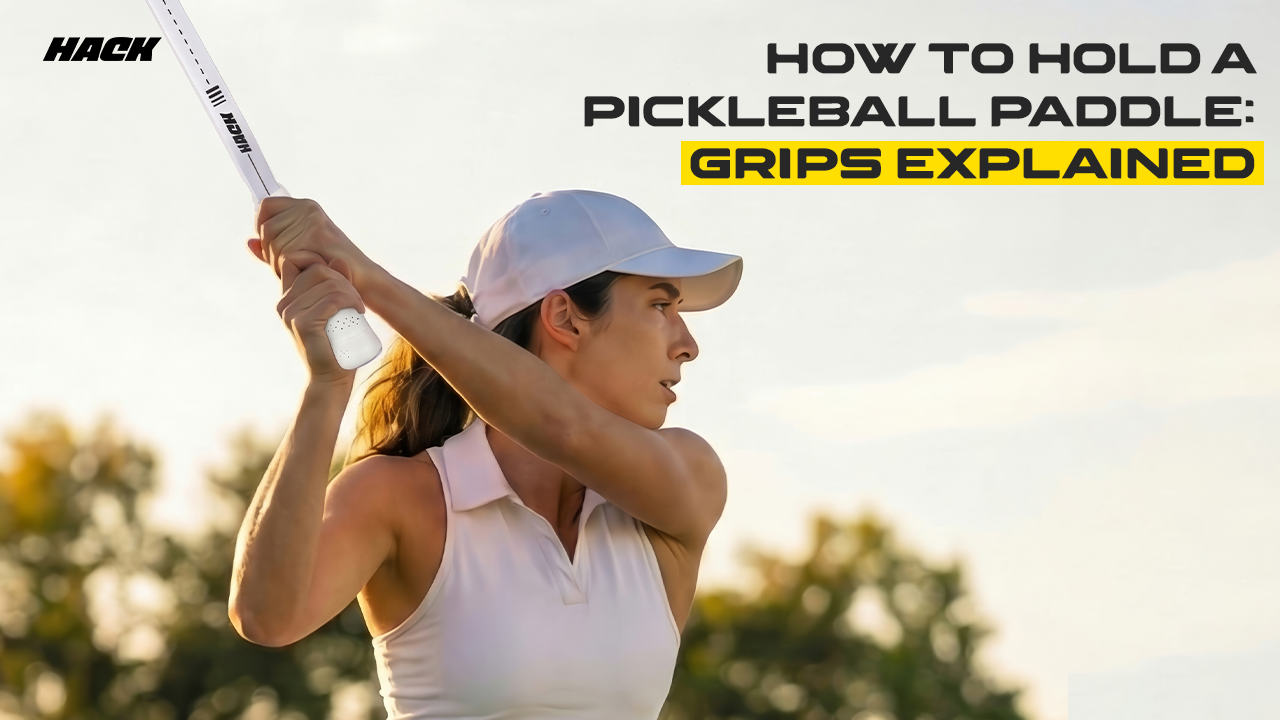
- Pickleball uses three primary grips: Continental, Eastern, and Western, named for the position of the index knuckle on the handle bevels.
- Continental is the most versatile and the standard grip for the majority of pickleball play, especially at the kitchen line.
- Eastern forehand suits players coming from tennis who want extra forehand power but slows backhand reactions.
- Western grip generates topspin on drives but is impractical at the non-volley zone where 70 percent of pickleball points are decided.
- Grip pressure should sit around 4 to 5 out of 10. Over-gripping is the most common technical fault among recreational players.
- Grip size and overgrip choice affect technique as much as the grip type itself. A handle that is too thin or thick distorts the entire stroke.
- What a Pickleball Grip Actually Means
- How Grip Position Affects the Shot
- Continental, Eastern, and Western Grips Compared
- When to Use Each Grip in a Real Game
- Grip Pressure, Wrist Position, and Feel
- How to Set Your Grip Step by Step
- Common Grip Mistakes That Cost Points
- Grip Size, Overgrips, and Handle Maintenance
- Expert Tips on Grip Transitions and Advanced Use
- Who Uses Each Grip Style
- Related Reading
- Frequently Asked Questions
The way you hold a pickleball paddle determines what your hand can do with it. It dictates which shots come naturally, which feel forced, and which are mechanically impossible. Most casual players never think about grip beyond picking up the paddle the same way every time. That habit is the single largest invisible cap on their improvement. This guide breaks down the three grips used in modern pickleball, explains exactly when to use each, and walks through the small adjustments that turn a usable grip into a reliable one. For the paddles tested against the grip techniques in this guide, browse the Hack Athletics pickleball collection.
Hack Athletics has built its paddle range around the grip habits of Indian club and competitive players. Handle shapes, bevel definitions, and grip materials are designed to make grip transitions natural rather than forced. The Hack Athletics design philosophy reflects the years of testing that went into building paddles for the way players actually move their hands during a rally.
Last reviewed: May 2026
1. What a Pickleball Grip Actually Means
A pickleball grip refers to the position of your hand around the paddle handle, specifically the location of the index knuckle on the handle's bevels. Modern paddle handles are octagonal in cross-section, with eight flat surfaces called bevels. Numbering them gives a precise reference for every grip type. Bevel one sits on top when the paddle is held with the face vertical and the butt cap toward your stomach. The remaining bevels number clockwise for right-handed players and counterclockwise for left-handed players.
The shake-hands reference
The simplest way to find your grip is the shake-hands position. Hold the paddle out in front of you with the face vertical, edge pointing at the opponent. Shake hands with the handle. The crease where your thumb meets your index finger should sit along the top edge of the handle. This is the Continental grip, the default starting point for almost every modern coach.
Why the index knuckle matters most
The base knuckle of your index finger is the reference landmark used in racquet sports to identify and name grips. Tracking only this knuckle position lets you verify your grip without looking at the rest of your hand. According to USA Pickleball coaching documentation, the index knuckle's position on the handle's bevels is the standardised way of describing every grip in instructional material.
Reference baseline: Right-handed Continental grip places the index knuckle on bevel two. Eastern forehand on bevel three. Western on bevel four or five. Left-handed players mirror these positions on the opposite side of the handle.
2. How Grip Position Affects the Shot
The grip changes the angle of the paddle face at the natural arm position. Every grip has a face angle it produces when the elbow is at the side and the wrist is neutral, and that angle determines which shots feel natural and which require active wrist manipulation to execute.
Forehand mechanics
The Continental grip produces a slightly open paddle face on the natural forehand swing, suited to flat or sliced shots. The Eastern grip produces a neutral or slightly closed face on the forehand, allowing easier topspin drives without conscious wrist work. The Western grip produces a heavily closed face, suited to high-bouncing balls and aggressive topspin.
Backhand mechanics
The Continental grip uses the same hand position for both forehand and backhand, which is why it dominates pickleball. The Eastern forehand requires either a slight rotation of the hand for backhands or a separate Eastern backhand grip. The Western forehand grip is mechanically difficult to play backhands from, often forcing the player to flip the paddle.
Volley and kitchen mechanics
At the non-volley zone, the speed of the exchange punishes any grip that requires adjustment between shots. The Continental grip survives this test cleanly. Eastern forehand users default back to Continental at the kitchen. Western users effectively cannot play modern pickleball at the line.
Spend five minutes at the start of every session checking your grip in the mirror or against a reference photo. Grip drift over weeks of play is one of the most common reasons technique gets worse without obvious cause.
3. Continental, Eastern, and Western Grips Compared
The three grips used in pickleball each have a specific profile of strengths and weaknesses. Choosing among them is a matter of matching the grip to the way you play, not picking the "best" one in isolation.
| Specification | Continental | Eastern | Western |
|---|---|---|---|
| Index knuckle bevel | Bevel 2 | Bevel 3 | Bevel 4 or 5 |
| Forehand power | Moderate | High | Very high with topspin |
| Backhand ease | Excellent, same grip | Requires partial change | Very poor |
| Net play and dinks | Excellent | Good with grip change | Poor |
| Topspin generation | Low to moderate | Moderate | High |
| Slice and cut shots | Excellent | Moderate | Difficult |
| Best for | All-court play, doubles | Tennis converts, singles baseliners | Heavy-topspin specialists only |
Why most coaches default to Continental
The combination of versatility, no required grip changes, and competence on every shot type means Continental wins on aggregate even though it does not lead in any single category. For the typical doubles-heavy play pattern seen at most Indian clubs, this matters more than peak forehand power. The Amplify Pro paddle is built around handle ergonomics that suit Continental grip players.
4. When to Use Each Grip in a Real Game
Theory aside, grip choice is decided in real game situations. Knowing which grip suits which moment lets you make conscious choices rather than defaulting to whatever your hand happens to be doing.
At the kitchen line (non-volley zone)
Always Continental. The speed and proximity of kitchen exchanges leave no time for grip changes. Hand speed and paddle face control matter more than power, and Continental delivers both with the smallest cognitive load.
On groundstrokes from the baseline
Continental works for everything. Eastern forehand adds power to flat and topspin drives if you have the time to set up. The trade-off is that you must change back to Continental as you approach the net, which costs a fraction of a second on the transition shot.
On serves and returns
Most players serve with their default groundstroke grip. Continental servers tend to slice or float the serve, which is easy to keep deep and low. Eastern servers hit flatter, harder serves. On returns, Continental's neutral face is almost always the safer choice, especially against deep, fast serves.
On putaways and overhead smashes
Continental dominates overheads, mirroring tennis grip conventions where the serve and overhead use the same hand position. The slightly open face suits the downward angle of the shot.
Court-time data: Tracking studies in elite pickleball show approximately 70 percent of all shots in a competitive doubles point happen within four feet of the non-volley line. This is why net-friendly grips dominate the pro game.
5. Grip Pressure, Wrist Position, and Feel
Grip type names the position of the hand. Grip pressure governs what the hand does once the paddle is in position. Almost every technical fault in club pickleball traces back to pressure problems rather than grip type problems.
The pressure scale
Pickleball coaches commonly use a 1 to 10 scale where 1 is barely holding the paddle and 10 is a maximum squeeze. The functional range for almost all shots sits at 4 to 5. Dinks and touch shots dip to 3. Drives and overheads rise to 6 or 7 momentarily at contact. Anything held above 7 for sustained periods produces forearm tension that ruins feel.
Wrist position
The wrist should be firm but not locked. A locked wrist transmits every off-centre vibration up the forearm and into the elbow, contributing to the lateral epicondylitis pattern documented by the American College of Sports Medicine. A correctly firm wrist absorbs the impact while keeping the paddle face stable.
Why grip and pressure interact
A Continental grip held at pressure 7 plays like a different grip than the same Continental grip held at pressure 4. Many players who think they need to change grip type actually need to change pressure. Try this before re-learning your grip entirely.
Most players over-grip in pressure moments such as the third shot drop or a defensive dink. Cue yourself before stressful shots by relaxing the grip deliberately for one breath, then re-setting at pressure 4.
Train with a paddle that rewards correct grip
Hack Athletics paddles are built with handles that locate naturally into the Continental position. Defined bevels and tacky grip surfaces make pressure adjustments easier to feel.
Shop Pickleball Paddles6. How to Set Your Grip Step by Step
Setting the grip correctly is a sequence of small checks. Run through them at the start of every session for the first few weeks until they become automatic.
Step one: orient the paddle
Stand in athletic stance. Hold the paddle out in front of you with the face vertical and the butt cap pointing toward your stomach. The top edge of the handle should be parallel to the ground.
Step two: place the index knuckle
For Continental, place your index knuckle on bevel two. For Eastern forehand, slide it one bevel clockwise (bevel three for right-handers). For Western, move it two more bevels.
Step three: close the hand naturally
Let your remaining fingers wrap around the handle without forcing them into position. Your thumb should sit either flat along the back of the handle (full wrap) or slightly elevated along the side (handshake style). Both are acceptable. Choose the one that feels natural and stay consistent.
Step four: check the V
The V formed by your thumb and index finger is your verification mark. In Continental, the V points roughly toward your right ear (for right-handed players). In Eastern, it points toward your right shoulder. In Western, it points down toward your right hip.
Step five: check grip size
With the paddle held in Continental, your ring finger should fit between your fingertips and the base of your palm. No gap means the grip is too small. Two-finger gap means too large. The Hack Athletics size and spec chart includes handle dimensions for each paddle model.
7. Common Grip Mistakes That Cost Points
The same handful of grip errors appear across every level of recreational play. Catching even one of them produces immediate gains in shot consistency.
Choking up too high on the handle
Many players unconsciously grip the paddle two or three centimetres above the butt cap, reducing the effective leverage of every swing. The base of your hand should sit just above the butt cap, with no significant gap. Choking up shortens the swing and reduces power without any compensating benefit.
Holding the paddle with all five fingers tight
Power and feel come from the bottom three fingers (ring, middle, and pinky) anchoring the paddle, while the index finger and thumb guide the face. Squeezing all five with equal pressure locks the wrist and removes the ability to angle the paddle face on touch shots.
Rotating the paddle unconsciously
Recreational players often pick up the paddle slightly differently every time, drifting toward Eastern on forehands and back to Continental on the next shot. This invisible drift causes inconsistent paddle face angles and is one of the hardest faults to diagnose without video review.
Ignoring grip when changing paddles
Switching from a paddle with a 4 1/4 inch grip to one with a 4 3/8 inch grip subtly changes the bevel positions. The Continental position is in the same place but feels different because the surrounding bevels are wider. Always re-set your grip when changing paddles.
Holding the paddle with the wrist permanently bent backward (a habit borrowed from tennis topspin technique) puts repeated stress on the forearm tendons. This is one of the leading contributors to pickleball elbow in players who used to play tennis.
8. Grip Size, Overgrips, and Handle Maintenance
The grip type matters less if the grip size, overgrip choice, and handle condition are wrong for your hand. These three factors determine how the paddle actually feels to hold.
Choosing grip size
Standard adult pickleball grip sizes are 4 inches, 4 1/8 inches, 4 1/4 inches, and 4 3/8 inches in circumference. The majority of Indian adult players use 4 1/4 inches. Players with very small hands or junior players should consider 4 inches. Larger-handed adults may prefer 4 3/8 inches. A grip that is too small encourages over-gripping. A grip that is too large reduces wrist mobility.
Why overgrips matter
Overgrips are thin layers wrapped over the stock handle to add tackiness, absorb sweat, and customise thickness. A fresh overgrip can make a worn-out paddle feel almost new. Two overgrips stacked add roughly one grip size, which is a fast way to fine-tune fit without buying a different paddle.
Handle maintenance
Replace overgrips every 4 to 8 weeks depending on play volume and humidity. Mumbai monsoon-season grips degrade twice as fast as dry-season grips. Wipe the handle with a mild cleaner once a month. Avoid wrapping a fresh overgrip over a sweat-saturated old grip without removing it first, as trapped moisture breeds bacterial growth and breaks down handle materials.
Storage in your bag
Store paddles handle-down in a ventilated section of a quality bag like the Hack Athletics 30L duffle gym bag. Leaving the handle pressed against wet towels or shoes destroys the overgrip and softens the underlying handle material over time.
9. Expert Tips on Grip Transitions and Advanced Use
Beyond the basics of grip type, there are a few habits coaches teach to help players progress from competent to dependable in their grip use.
Practising grip changes off court
Sit on your couch and rotate the paddle between Continental, Eastern, and back to Continental fifty times in a sitting. Do this for a week. The motion becomes automatic and the time cost of a grip change drops from a noticeable pause to an unconscious adjustment.
Grip in defensive transitions
When you are pushed back from the kitchen and forced into a defensive position, the natural impulse is to tighten the grip. Resist it. A defensive shot from the transition zone is exactly when you need the touch that pressure 3 to 4 provides. Coaching material from the leading pickleball coaching publications consistently emphasises that grip pressure should drop, not rise, under defensive stress.
Reading opponent grips
Watching an opponent's grip before they hit gives you a half-second of preparation. A locked-in Continental tells you to expect a controlled shot. A visible grip shift toward Eastern signals an attempted power drive. Most amateur players telegraph grip changes obviously, and this is exploitable.
Cross-sport grip principles
Players coming from squash, badminton, or tennis bring grip habits from those sports. The principles of grip pressure regulation and wrist alignment transfer cleanly across racquet sports. Reviews from the United States Tennis Association on grip ergonomics describe the same wrist and forearm mechanics that apply to pickleball, and broader injury-prevention principles from the National Strength and Conditioning Association reinforce the same fundamentals.
Coaching cue: The phrase used most often by elite coaches is "soft hands, firm wrist." This single mental cue addresses both grip pressure and wrist position simultaneously and is worth repeating to yourself before every dink rally.
10. Who Uses Each Grip Style
Grip selection patterns by player background and playing style. Knowing where you fit helps you decide whether your current grip is serving you or holding you back.
- Most recreational and intermediate doubles players
- Players coached by certified pickleball coaches
- Squash and badminton converts who already use Continental-style grips
- Net specialists who play most of their shots at the kitchen line
- Tennis converts retaining their forehand grip
- Singles players who want extra power on baseline drives
- Players with strong wrist control who can switch grips mid-rally
- Hard-serve specialists using a flatter, faster serve
- A small minority of heavy-topspin specialists
- Players competing primarily in singles at intermediate levels
- Topspin baseline strikers (rare in modern pickleball)
- Players who are still experimenting and have not settled yet
- Continental is the default grip for pickleball. It works for forehands, backhands, volleys, and dinks without grip changes.
- Eastern suits tennis converts and singles players willing to change grips mid-rally for added forehand power.
- Western is rarely used in modern pickleball because it makes net play and backhands too difficult.
- Grip pressure at 4 to 5 out of 10 is the sweet spot. Dink shots dip to 3. Over-gripping is the most common technical fault.
- The index knuckle position on the handle bevels is the standardised reference for naming grips.
- Grip size, overgrip choice, and handle condition affect feel as much as the grip type itself. Replace overgrips every 4 to 8 weeks.
11. Related Reading
12. Frequently Asked Questions
What is the most common pickleball grip?
The Continental grip is the most common grip in pickleball, used by the majority of intermediate and advanced players. It allows the same hand position to handle forehands, backhands, volleys, dinks, and serves without changing grip mid-rally. The hand and the paddle face share the same plane, which simplifies decision making during fast kitchen exchanges.
Which grip should a beginner start with?
Beginners should start with the Continental grip. It is the most versatile, requires no grip changes during a point, and develops the wrist positions used at higher levels. Players coming from tennis with a strong Eastern forehand can stick with that grip initially, but most will gradually shift to Continental as their net game develops. The Amplify Pro paddle is a typical first-paddle recommendation for this profile.
How tight should I grip a pickleball paddle?
Grip pressure should sit around 4 to 5 on a scale of 1 to 10, where 10 is a maximum squeeze. Firm enough that the paddle does not twist on off-centre contact, loose enough that the wrist and forearm stay relaxed. Many players over-grip on stressful shots, which kills feel on dinks and slows hand speed at the line.
Do I need to change grip between forehand and backhand?
Not in pickleball. The pace of the game and the short distances at the kitchen line make grip changes impractical. The Continental grip handles both wings cleanly. Eastern users often change slightly between sides in groundstroke play, but at the net they default back to Continental. Western users almost always have to flip the paddle for backhands, which is one reason the grip is less popular.
Why do my dinks pop up over the net?
The most common cause is excess grip pressure squeezing the paddle face up on contact. The second is a paddle face that is open (tilted back) rather than neutral. Loosen the grip to a 3 or 4 on the pressure scale and check that the paddle face is roughly vertical at contact. The shoulder, not the wrist, should drive the dink stroke.
Should I use a Western grip in pickleball?
Generally no. The Western grip is rarely used in modern pickleball because the fast pace at the kitchen line punishes any grip that requires a flip for backhands. It can be useful for heavy topspin drives from the baseline, but most players who try it in club play give it up within a few sessions. Stick with Continental or Eastern.
How do I find the right grip size?
The standard test is to hold the paddle in a Continental grip and check whether your ring finger can fit comfortably between your fingertips and the base of your palm. If there is no gap, the grip is too small. If you can fit two fingers, it is too large. Standard pickleball grip sizes run 4 1/4 inches to 4 3/8 inches for most adult players. The Hack Athletics size chart details handle circumference for each paddle model.
Can I improve my grip without buying a new paddle?
Yes. Adding an overgrip is the cheapest and most effective adjustment. Overgrips also let you build up grip thickness, change tackiness, and refresh worn handles without replacing the paddle. Most competitive players replace overgrips every 4 to 8 weeks depending on play volume and humidity.
What is the index knuckle and why does it matter for grip?
The index knuckle is the base knuckle of your index finger, used as the reference point for naming grips. Continental places this knuckle on bevel two of an octagonal handle. Eastern forehand places it on bevel three. Western places it on bevel four or five. Tracking your index knuckle position is the fastest way to verify your grip is correct before a serve or return.