






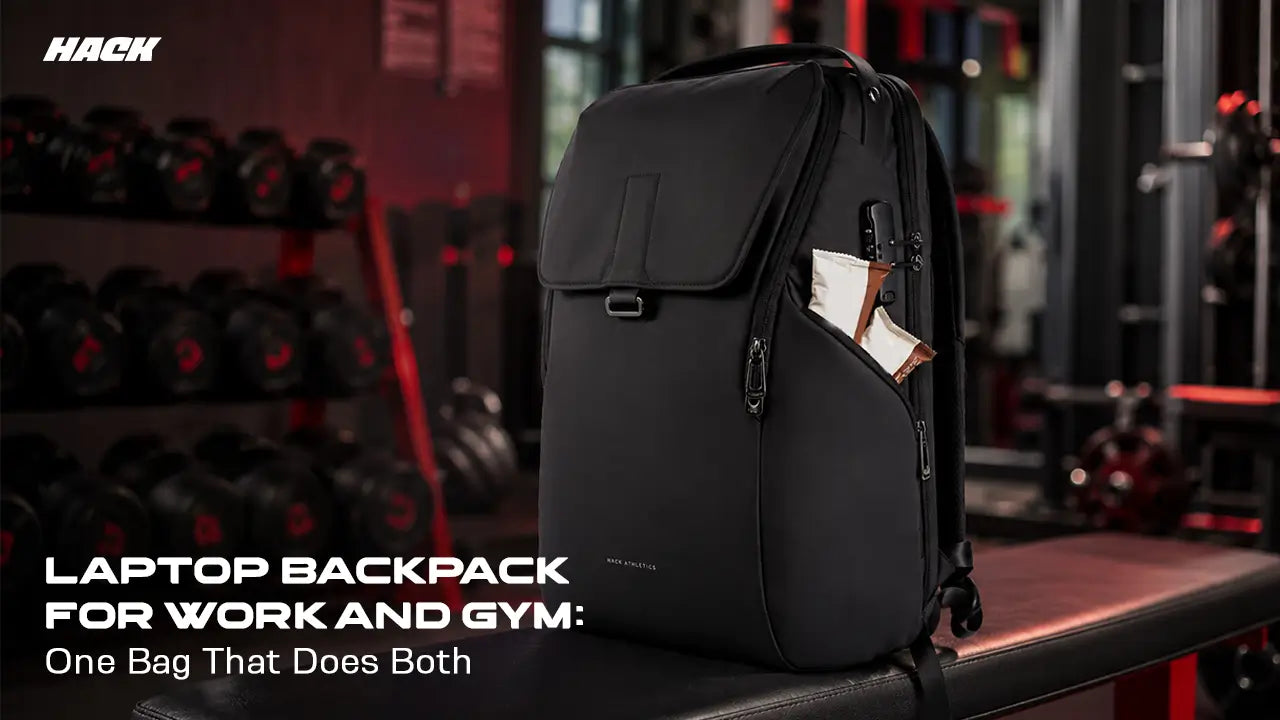
- A genuinely separate, padded laptop compartment is what makes a single backpack safe for both work tech and gym gear.
- Around 30 liters is a practical capacity sweet spot for fitting a laptop, documents, a change of clothes and shoes without excess bulk.
- Orthopedic guidance from the American Academy of Orthopaedic Surgeons recommends both shoulder straps be used evenly to avoid uneven spinal loading.
- A peer-reviewed review of backpack biomechanics found that symmetric, well-positioned loads reduce postural strain compared to one-shoulder carry.
- Anti-theft features like a keyless number lock add a practical layer of security during commutes and gym sessions.
- Water-resistant fabric and genuine YKK zippers matter more for long-term durability than most buyers initially expect.
- 1. Why One Bag for Work and Gym Actually Works
- 2. The Compartment Layout That Makes It Possible
- 3. Full Feature Breakdown
- 4. Who Benefits Most From a Combo Backpack
- 5. Backpack Ergonomics: Carrying It Right
- 6. Security Features That Matter for Daily Carry
- 7. How to Choose the Right Size and Layout
- 8. Common Mistakes When Buying a Combo Bag
- 9. Packing It Right: Office to Gym in One Load
- 10. Backpack vs Duffle for Office Use
- 11. Related Reading
- 12. Frequently Asked Questions
Carrying a laptop bag on gym days and a separate gym bag on other days gets old fast. A genuinely good laptop backpack for work and gym removes that choice entirely, provided it is built with the right compartment layout, not just a gym bag with a sleeve stitched in as an afterthought. It is a small logistical shift that adds up to real time and mental energy saved over months of daily commuting.
Hack Athletics builds gear for people who train seriously around a full working life, not around it. You can read more about that approach on the about us page.
This guide covers what actually makes a combo backpack work in daily use, the ergonomics of carrying it comfortably, and how to pack it so your laptop and gym gear never compete for space.
Last reviewed: July 2026
1. Why One Bag for Work and Gym Actually Works
The idea of a single bag for both work and gym sounds like a compromise on paper, but in practice it removes a daily decision entirely: pack once in the morning, and the same bag covers a full day that includes both a desk and a workout.
Core requirement: This only works if tech storage and general carry space are genuinely separated inside the bag, not sharing the same compartment.
Where the "gym bag with a laptop sleeve" approach fails
Many gym bags add a laptop sleeve as an afterthought, positioned against the same wall as damp shoes or sweaty clothes. A true work-to-gym backpack, such as the Hack Athletics Mono 30L Laptop Backpack, is designed the other way around, with a dedicated, padded compartment for a laptop up to 16 inches that never shares space with gym gear.
2. The Compartment Layout That Makes It Possible
A workable combo backpack needs at least three distinct zones: a padded laptop and document compartment, a spacious main compartment for clothes and shoes, and quick-access side pockets for small daily items like cables, snacks or a phone.
Check whether the laptop compartment is fully separated by its own zip and panel, rather than just an open sleeve inside the main space. Full separation is what actually protects your tech.
The Mono 30L's main compartment is intentionally generous, built to hold gym clothes, shoes and daily carry items without feeling bulky, which is the detail that lets it function as an office-to-gym bag rather than strictly an office bag with gym pretensions.
3. Full Feature Breakdown
The table below breaks down the features that separate a genuine work-to-gym backpack from a standard laptop bag or standard duffle.
| Feature | Why It Matters |
|---|---|
| Padded laptop compartment, up to 16" | Keeps tech protected and fully separate from gym gear |
| Spacious main compartment | Fits clothes, shoes and daily items without excess bulk |
| Quick-access side pockets | Fast reach for cables, snacks or small accessories |
| Anti-theft number lock | Adds security during commutes, gym sessions and travel |
| Water-resistant fabric | Protects contents from rain and sweat exposure |
| Genuine YKK zippers | Smooth, long-lasting operation under daily use |
Comparisons of backpacks against single-shoulder alternatives consistently favor the two-strap design for anyone carrying real weight. A practical breakdown from EUME's backpack versus shoulder bag comparison notes that once daily carry exceeds roughly 3kg, a backpack becomes measurably better for posture and comfort over a shoulder bag, which is relevant the moment a laptop, charger and gym gear are all packed together.
4. Who Benefits Most From a Combo Backpack
Professionals who train before or after work, without going home first, are the clearest fit. A single 30-liter bag replaces both a laptop bag and a separate gym duffle, which matters on days that already involve enough logistics.
Hybrid workers and commuters
Anyone splitting time between office days and home days benefits from a bag that works equally well for a laptop-only commute and a full gym-plus-laptop day, without needing to switch bags depending on the day's plan.
Practical note: If your gym is on the way to or from the office, rather than requiring a separate trip, a combo backpack removes an entire extra bag from your daily routine.
Lifters who carry belts, sleeves and straps
If your gym bag already needs to carry a weightlifting belt, knee sleeves or wrist wraps alongside a change of clothes, the Mono 30L's main compartment has the room to hold all of it without needing a second bag for accessories, which is a common pain point for lifters who train seriously around a full-time job.
5. Backpack Ergonomics: Carrying It Right
How you wear a loaded backpack matters as much as what is inside it. OrthoInfo from the American Academy of Orthopaedic Surgeons recommends using both wide, well-padded shoulder straps to distribute weight evenly, and packing heavier items low and close to the back rather than at the top or pressed away from the body.
Carrying any backpack on one shoulder concentrates load asymmetrically on the spine. Use both straps, especially once a laptop and gym gear are both packed in.
See the Mono 30L in Detail
Padded laptop storage, spacious main compartment, and anti-theft security in one backpack.
Shop Backpacks & Gym BagsA peer-reviewed narrative review of the biomechanical and physiological effects of backpacks confirms that carrying a load with both shoulder straps, rather than asymmetrically, produces meaningfully less postural deviation and trunk muscle strain, reinforcing that how you wear a bag matters alongside how it is designed.
6. Security Features That Matter for Daily Carry
An integrated keyless number lock is a small feature that earns its place quickly once you are regularly leaving a bag on a gym rack, in a shared office space, or checked briefly during travel. It will not stop a determined thief, but it removes casual opportunistic access, which covers the majority of realistic daily risk.
General workplace ergonomics guidance from the Occupational Safety and Health Administration also underscores that reducing unnecessary physical strain, including from how loads are carried through a commute, is a meaningful part of preventing musculoskeletal complaints in daily working life. Guidance aimed at parents and students from the Iowa Ortho backpack safety overview reinforces the same core principles: keep the bag close to the body, use both straps, and avoid letting the bag hang more than a few inches below the waistline, guidance that applies just as well to adult commuters as it does to students.
7. How to Choose the Right Size and Layout
Work through these questions:
- Do you need a full change of clothes and shoes, or just a laptop most days? A 30L bag comfortably covers both without feeling oversized on laptop-only days.
- How large is your laptop? Confirm the padded compartment fits your specific size, generally up to 16 inches on a bag like the Mono 30L.
- Do you need document storage alongside the laptop? Look for compartments that fit an iPad or folder alongside the laptop sleeve itself.
- How security-conscious is your commute or gym environment? An anti-theft lock is worth prioritizing if you regularly leave the bag unattended.
8. Common Mistakes When Buying a Combo Bag
The most common mistake is buying a bag purely on laptop protection without checking whether the main compartment genuinely fits gym clothes and shoes, resulting in a bag that works for the office but not for training days.
Avoid bags where the laptop sleeve sits inside the same open compartment as everything else. Sweat, moisture and shoe contact are the most common causes of avoidable laptop damage in shared-compartment designs.
Another frequent mistake is choosing a bag based on looks alone without checking build details like zipper brand and fabric water resistance, both of which determine how the bag holds up after months of daily use rather than how it looks on day one.
9. Packing It Right: Office to Gym in One Load
Place your laptop and any documents in the dedicated tech compartment first, then load gym clothes and shoes into the main compartment, keeping heavier items like shoes toward the bottom and closer to your back for better weight distribution.
Use the side pockets for items you need quick access to throughout the day, such as a phone, wallet, or a water bottle, so you are not digging through the main compartment every time you need something small. A shaker bottle for a post-workout mix also fits comfortably in a side pocket or the main compartment without risking contact with your laptop compartment.
If you train with additional accessories such as lifting straps or a spare set of knee sleeves, a small internal pouch or zippered pocket keeps them separate from clean clothes, which matters more once you are packing for a full office-to-gym day rather than a gym-only trip.
10. Backpack vs Duffle for Office Use
A duffle bag, such as the Hack Athletics 30L Duffle Gym Bag, is excellent for pure gym use and offers strong wet-dry separation, but it visually reads as gym gear in a way a well-designed backpack does not.
Practical distinction: If your day includes client meetings, formal office settings, or any environment where appearance matters, a laptop backpack blends in far more easily than a duffle. If your day is purely gym-focused, a duffle's dedicated wet-dry storage may be the better fit.
Some lifters end up owning both: a backpack for standard office-to-gym days, and a duffle reserved for weekend training blocks or travel where laptop protection is not a factor at all. Neither choice is wrong, since the two bags are solving genuinely different problems even though they overlap in gym-carry capability.
- A genuinely separate, padded laptop compartment is what makes one backpack work for both office and gym.
- 30 liters is a practical capacity for a laptop, documents, a change of clothes and shoes without excess bulk.
- Use both shoulder straps evenly, and pack heavier items low and close to your back.
- An anti-theft number lock adds real, practical security for commutes and gym sessions.
- Water-resistant fabric and genuine YKK zippers matter more for long-term durability than initial appearance.
- A backpack generally reads as more office-appropriate than a duffle bag in professional settings.
11. Related Reading
12. Frequently Asked Questions
Can one backpack really work for both office and gym use?
Yes, provided it separates tech storage from general carry space. A dedicated padded laptop compartment protects work essentials, while a spacious separate main compartment holds gym clothes, shoes and daily items without the two ever touching or feeling cramped.
How big should a work-to-gym backpack be?
Around 30 liters is a practical sweet spot. It is large enough to fit a change of clothes, shoes and daily essentials alongside a laptop, without becoming so bulky that it looks out of place in a professional setting.
Will a laptop get damaged if gym clothes are packed in the same backpack?
Not if the backpack has a genuinely separate, padded laptop compartment, like the Hack Athletics Mono 30L. The risk comes from bags that only have one main compartment, where a laptop can end up pressed against shoes or damp clothing. A dedicated compartment removes that risk entirely.
Is a 30L backpack too heavy to carry with a laptop already inside?
Padded, wide shoulder straps distribute weight evenly across both shoulders, which matters more for comfort than raw capacity. A 30L bag loaded with a laptop and gym gear is well within the range padded straps are designed to carry comfortably for a commute.
Do anti-theft backpack features actually help in daily use?
A keyless number lock adds a meaningful layer of security during commutes, gym sessions and travel, when a bag is briefly out of direct sight or left in a locker or on a rack. It is a simple deterrent rather than a guarantee, but it closes an easy opportunity for casual theft.
What size laptop fits in a work-to-gym backpack like this?
The Hack Athletics Mono 30L Laptop Backpack fits laptops up to 16 inches in its padded compartment, with additional room for an iPad or tablet and documents alongside it.
Is a backpack more professional-looking than a gym duffle bag for the office?
A well-designed laptop backpack in a clean silhouette generally reads as more office-appropriate than a duffle bag, which tends to visually signal gym use specifically. A backpack with organized compartments and a professional finish blends into an office setting far more easily.
How do I pack a work-to-gym backpack to avoid back strain?
Place your heaviest items, typically a laptop and any weights or dense gear, in the compartment closest to your back, and use both shoulder straps evenly rather than slinging the bag over one shoulder. This keeps the load closer to your center of gravity and reduces strain over a commute.