






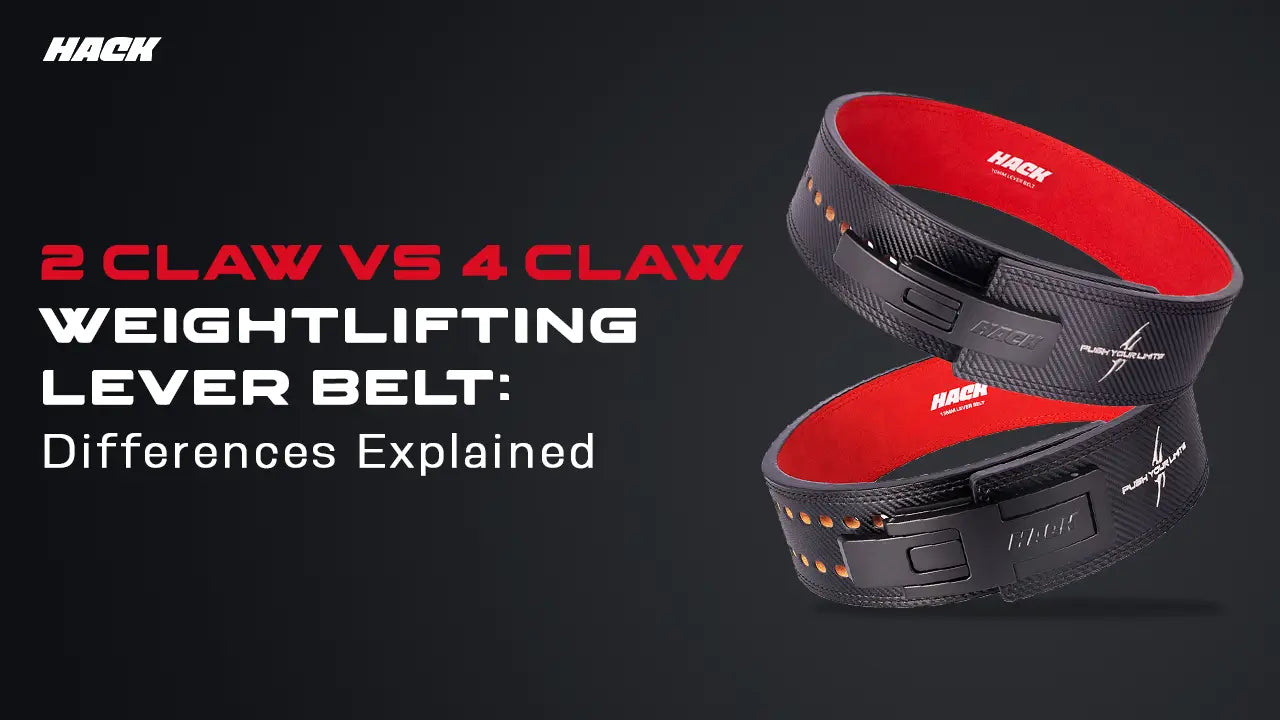
- Claw count refers to the number of teeth on the lever's metal mounting plate, not the belt's thickness or bracing strength.
- Hack Athletics offers 13mm lever belts in both 2 claw and 4 claw builds, while every 10mm lever belt uses a 2 claw mount.
- A 4 claw mount spreads clamping force across four anchor points, which can help the mechanism sit flatter on thicker 13mm leather.
- IPF and USA Powerlifting equipment rules govern belt width and thickness, not claw count, so both configurations are equally competition legal.
- Claw count is not a field-convertible feature. The mounting plate is fixed during manufacturing.
- First-time lever belt buyers generally do better starting with a 10mm 2 claw belt before stepping up to 13mm.
- 1. What "Claw Count" Actually Means
- 2. How the Lever Mount Works Mechanically
- 3. 2 Claw vs 4 Claw, Specification Comparison
- 4. Which Hack Athletics Belts Use Which Mount
- 5. Does Claw Count Change Bracing Performance?
- 6. Competition Legality and Claw Count
- 7. How to Choose Between 2 Claw and 4 Claw
- 8. Common Mistakes When Buying a Lever Belt
- 9. Sizing, Fit and Break-In
- 10. Who Buys 2 Claw vs 4 Claw Belts?
- 11. Related Reading
- 12. Frequently Asked Questions
If you have shopped for a lever belt and noticed some 13mm listings say "2 Claw" while others say "4 Claw," you are not imagining a typo. It is a real construction difference, and the 2 claw vs 4 claw lever belt question is worth understanding before you buy, since it changes how the lever mechanism itself is built into the belt.
Hack Athletics builds both configurations because different lifters have different preferences for how the lever mount feels and sits on the belt. You can read more about our approach to belt construction on the about us page.
This guide breaks down exactly what claw count means, how it differs from belt thickness, and which configuration fits your training, so you are choosing based on what actually changes performance rather than guessing from a product title.
Last reviewed: July 2026
1. What "Claw Count" Actually Means
A lever belt's buckle is not simply glued or riveted to the leather at a single point. It is attached using a metal mounting plate secured to the belt with screws, which is what allows the lever to be repositioned as your body composition changes. Claw count refers to the number of teeth, or anchor points, on that mounting plate.
Simple definition: A 2 claw mount uses two anchor points to secure the lever to the belt. A 4 claw mount uses four, spreading the same clamping force across a wider footprint.
Why this is different from thickness
Thickness, whether 7mm, 10mm or 13mm, describes the leather itself and how rigid the belt feels once braced against. Claw count describes only how the lever buckle is fastened to that leather. The two specs are independent, though in practice Hack Athletics only offers 4 claw mounts on its thicker 13mm builds.
It helps to think of claw count the way you might think of the number of bolts holding a bracket to a wall. More bolts do not make the bracket itself stronger, but they do spread the load across more points of contact, which can matter when the material being clamped is under repeated stress. That is roughly the same relationship claw count has to the belt's leather.
2. How the Lever Mount Works Mechanically
Every lever belt uses a back plate and screws to hold the lever assembly in place, which is also what allows the lever to be moved to a new hole position with an Allen key as your measurements change over time. A 2 claw mount concentrates that holding force at two points; a 4 claw mount spreads it across four.
More anchor points generally mean the plate resists twisting or shifting slightly better under repeated heavy loading, which matters most on the thickest, stiffest leather.
This is consistent with how the broader lever belt category is engineered: the lever is attached to the belt with a back plate and screws, creating a fixed position that can be adjusted by removing and repositioning the plate, rather than by simply pulling a prong tighter. A detailed breakdown of this mechanism from Garage Gym Lab's lever belt vs prong belt guide confirms that the back plate and screw assembly is standard across the category, regardless of how many anchor points a specific manufacturer's plate uses.
It is worth noting that neither claw configuration changes how quickly you can open or close the lever mid-session. Both still operate with the same one-second flick that lever belts are known for, since claw count only affects the fixed connection between plate and leather, not the moving lever arm itself.
3. 2 Claw vs 4 Claw, Specification Comparison
The table below lines up what actually changes between the two mounts, and what stays identical.
| Spec | 2 Claw Mount | 4 Claw Mount |
|---|---|---|
| Anchor points | 2 | 4 |
| Available thickness | 10mm and 13mm | 13mm only |
| Bracing performance | Determined by thickness, identical at same mm | Determined by thickness, identical at same mm |
| Competition legal | Yes, subject to federation approved list | Yes, subject to federation approved list |
| Adjustability | Allen key reposition, same process | Allen key reposition, same process |
| Field convertible | No, fixed during manufacturing | No, fixed during manufacturing |
4. Which Hack Athletics Belts Use Which Mount
The 13mm Lever Belt (4 Claw) and the 13mm Lever Belt Carbon Fiber (4 Claw) are the current 4 claw builds in the range. If you prefer a 2 claw mount on the same 13mm leather, the 13mm Lever Belt Carbon Fiber (2 Claw) and 13mm Lever Belt Signature Red (2 Claw) use the identical 13mm leather with a 2 claw lever mount instead.
Every 10mm lever belt in the range, including the 10mm Lever Belt, Signature Red and Carbon Fiber colorways, uses a 2 claw mount. If you also want an adjustable, screwdriver-free option, the Quick Locking Weightlifting Belt uses a completely different closure system, which is worth knowing about even though it sits outside the claw comparison entirely.
Quick reference: 7mm belts are prong-style, not lever, so claw count does not apply to the 7mm Prong Belt at all.
Color and finish tend to track claw configuration in the current lineup rather than the other way around, which is simply a reflection of how each colorway was manufactured. If a specific finish matters more to you than claw count, check the individual product listing to confirm which mount that particular belt uses before adding it to your cart.
5. Does Claw Count Change Bracing Performance?
No. The amount of intra-abdominal pressure support you get from a belt comes primarily from thickness and width, not from how the lever is mounted. Foundational research on lifting belts, including an early controlled study on intra-abdominal pressure during weightlifting with a belt, ties bracing benefit to belt rigidity and how effectively the lifter braces against it, not to buckle hardware.
Do not choose 4 claw over 2 claw expecting a stronger brace. Choose based on thickness first, and claw preference second, since claw count is a mounting detail, not a support spec.
Where claw count can make a subtle difference is how flush the mounting plate sits against very thick, stiff 13mm leather under repeated maximal loading, since more anchor points distribute clamping force more evenly across a wider area of material. This distinction matters more to equipment engineering than to the physiological effect of the belt itself, which the NSCA's Strength and Conditioning Journal review of lifting belt research ties to thickness, width and lifter bracing technique rather than buckle hardware.
6. Competition Legality and Claw Count
Federation equipment rules focus on belt width, thickness and general construction. The International Powerlifting Federation's technical rules specify a maximum 4 inch width and 13mm thickness, without a claw-count restriction, and USA Powerlifting's rulebook follows a similar structure.
In practice, this means a 2 claw and 4 claw belt of the same width and thickness are equally legal for competition, provided the manufacturer appears on the federation's current approved equipment list, which can change and is worth checking before a meet.
7. How to Choose Between 2 Claw and 4 Claw
Work through these questions:
- Do you want 10mm or 13mm? 10mm is 2 claw only. 13mm gives you a choice.
- Do you have a strong preference either way? Most lifters do not notice a meaningful difference in daily use and can choose based on colorway or price alone.
- Are you training near-maximal loads regularly? Some lifters training at the top end of 13mm loading prefer the 4 claw mount for the added anchor points on very stiff leather.
Compare Lever Belt Builds
See the full 2 claw and 4 claw 13mm range side by side, alongside every 10mm option.
Shop Weight Lifting Belts8. Common Mistakes When Buying a Lever Belt
The most common mistake is assuming 4 claw automatically means "stronger" or "better," and paying a premium for it without understanding that thickness, not claw count, is what actually changes bracing support.
Do not expect to convert a 2 claw belt to 4 claw later, or vice versa. The mounting plate is fixed at manufacturing and is not a field-serviceable upgrade.
Another frequent mistake is sizing off pant size instead of a direct belly-button measurement, an error that applies equally to both claw configurations and is one of the most common reasons a new belt does not fit as expected.
9. Sizing, Fit and Break-In
Sizing works the same way for both mounts: measure around your belly button with clothes on, not your pant size, and match that figure to the correct chart. Hack Athletics maintains a dedicated 13mm Lever Belt 2 Claw size chart alongside the general 13mm Lever Belt size chart, since mount position can shift slightly between builds.
Break-in time is governed by leather thickness, not claw count, so a 13mm belt in either configuration needs the same gradual break-in period before your first maximal session in it. Wearing the belt for lighter warm-up sets in the days before a heavy session lets the leather begin conforming to your torso, regardless of which mount is fastened to it.
Once broken in, day-to-day maintenance is also identical between the two builds: wipe the inner surface after sweaty sessions, let the belt dry naturally away from direct heat, and avoid dropping the belt directly onto the lever mechanism, which is the one action that can genuinely damage either mount over time.
10. Who Buys 2 Claw vs 4 Claw Belts?
- Claw count describes the lever's mounting hardware, not belt thickness or bracing strength.
- Hack Athletics 13mm belts come in both 2 claw and 4 claw builds; 10mm belts are 2 claw only.
- Bracing support comes from thickness and width, not from claw count.
- Both configurations are equally legal under IPF and USA Powerlifting equipment rules.
- Claw count is fixed at manufacturing and cannot be converted later.
- Size using a belly-button measurement and the correct build-specific chart.
11. Related Reading
12. Frequently Asked Questions
What does claw count actually mean on a lever belt?
Claw count refers to the number of teeth on the metal mounting plate that anchors the lever mechanism to the leather. A 2 claw mount uses two anchor points, while a 4 claw mount uses four, spreading clamping force across a wider area of the belt.
Does a 4 claw lever belt feel stronger than a 2 claw belt?
The bracing support you feel comes from the belt's thickness and width, not the claw count. A 4 claw mount distributes the lever's clamping force across more anchor points, which can help the mechanism sit flatter and more evenly on thicker 13mm leather, but it does not change how much intra-abdominal pressure the belt itself supports.
Can I buy a 10mm belt with a 4 claw lever?
Not in the Hack Athletics range. All 10mm lever belts use a 2 claw mount, while 13mm lever belts are available in both 2 claw and 4 claw versions depending on the colorway. Thickness and claw count are separate specs, but in practice 4 claw mounts are only offered on the thicker 13mm builds.
Does claw count affect competition legality?
No. IPF and USA Powerlifting equipment rules govern belt width, thickness and general construction, not the number of anchor points on the lever mounting plate. A 2 claw and 4 claw belt of the same width and thickness are equally legal, provided the manufacturer is on the federation's current approved list.
Is a 2 claw or 4 claw belt easier to size correctly?
Sizing is based on belly-button circumference in both cases, not claw count. Hack Athletics provides a dedicated size chart for the 13mm 2 claw belt separate from the general lever belt chart, since mount position can shift slightly between the two builds.
Which belt should a first-time lever belt buyer choose?
Most first-time lever belt buyers do well starting with a 10mm 2 claw belt. It is easier to break in, less stiff through a full range of motion, and still provides strong bracing support for general strength training before stepping up to a 13mm belt.
Do 2 claw and 4 claw belts wear differently over time?
Both mounts are built to be permanent fixtures on the belt and are not designed to be removed during normal use. Provided the belt is not repeatedly dropped on the lever mechanism, claw count has little bearing on long-term durability.
Can I convert a 2 claw belt to a 4 claw mount?
No. The mounting plate is fixed to the belt during manufacturing and is not a user-serviceable or field-convertible part. If you want a specific claw configuration, choose it at the time of purchase rather than planning to modify the belt later.