








- Most lifting-related wrist pain comes from excessive wrist extension under load during pressing and front squat movements, not a single acute injury.
- According to OrthoInfo from the American Academy of Orthopaedic Surgeons, ligament sprains are graded 1 to 3 depending on severity, and grading changes the correct recovery approach.
- Wrist wraps work by limiting hyperextension, which is why they help pressing-related pain but do little for grip-fatigue or genuine ligament injuries.
- Hack Athletics offers both flexible and stiff wrist wraps, matched to lighter accessory work versus maximal pressing days respectively.
- Persistent pain, swelling, numbness or bruising are signals to see a doctor rather than wrapping through the discomfort.
- Correct bar position in the palm during bench press is one of the simplest, most overlooked fixes for chronic wrist strain.
- 1. What Wrist Pain From Lifting Actually Means
- 2. How Wrist Strain Develops Under Load
- 3. Common Causes, Compared
- 4. Which Lifts Cause the Most Wrist Pain
- 5. Fixes That Work Before You Reach for Wraps
- 6. When and How to Use Wrist Wraps
- 7. Mistakes That Make Wrist Pain Worse
- 8. Recovery, Rest and Ongoing Care
- 9. When to See a Doctor
- 10. Who Benefits Most From Wrist Wraps?
- 11. Related Reading
- 12. Frequently Asked Questions
Wrist pain from lifting weights is one of the most common, and most avoidable, complaints in a barbell gym. Before deciding whether you need a pair of wrist wraps, a technique fix, or a proper rest period, it helps to understand exactly what kind of strain is happening and why.
Hack Athletics builds pressing and bracing gear for lifters who train hard, and part of that is being honest about what a product can and cannot fix. You can read more about our approach on the about us page.
This guide walks through the real causes of lifting-related wrist pain, the fixes that work before you reach for support gear, and exactly when wrist wraps genuinely help versus when they simply mask a problem that needs attention.
Last reviewed: July 2026
1. What Wrist Pain From Lifting Actually Means
Not all wrist pain in the gym is the same injury wearing different clothes. It generally falls into three categories: overuse strain from repetitive extension under load, tendonitis from repeated gripping and pressing, and acute sprains from a fall or sudden twist. According to OrthoInfo from the American Academy of Orthopaedic Surgeons, sprains and strains are graded from mild stretching to a complete ligament tear, and that grading materially changes how long recovery takes.
Distinction that matters: A strain involves a muscle or tendon, while a sprain involves a ligament connecting two bones. Both are common in the wrist, but they respond to different care.
Why lifters get this specific injury more than most gym-goers
The wrist is not designed to be a primary load-bearing joint the way the shoulder or hip is. In practice, lifters report that the wrist becomes a limiting joint specifically because barbell training places it under repeated compressive and extension load, session after session, in a way that most daily activity never does.
The National Institute of Arthritis and Musculoskeletal and Skin Diseases notes that sprains and strains are among the most common musculoskeletal complaints, and that both can range from mild discomfort to injuries requiring extended recovery depending on severity. This is worth keeping in mind before assuming every twinge in the wrist is minor, or conversely, before assuming every twinge needs immediate medical attention. Most lifting-related wrist pain sits somewhere in the middle: real enough to address, but manageable with the right adjustments.
2. How Wrist Strain Develops Under Load
Every pressing and front-loaded movement asks your wrist to extend backward while supporting significant weight. Over time, if that extension exceeds what your tendons and ligaments comfortably tolerate, or if it happens repeatedly without adequate recovery, small amounts of tissue irritation accumulate into tendonitis or a genuine sprain.
A common observation among experienced lifters is that wrist pain rarely appears out of nowhere. It usually builds gradually over several sessions before becoming noticeable, which means small early warning signs are worth listening to.
Research summarized by the National Institutes of Health's StatPearls resource on wrist conditions notes that repetitive overuse is a well-established contributor to wrist joint stress over time, alongside acute trauma.
3. Common Causes, Compared
Not every cause of wrist pain calls for the same fix. The table below breaks down the most common causes lifters run into, what typically triggers them, and the most effective first response.
| Cause | Typical Trigger | First Response |
|---|---|---|
| Wrist extension strain | Bench press, overhead press, front squat rack position | Bar position correction, wrist wraps |
| Tendonitis | Repetitive pressing and gripping over weeks | Reduce volume, active rest, wraps for heavy days |
| Grip fatigue | Heavy pulling, deadlifts, high rep rows | Lifting straps, grip strength work |
| Acute sprain | Fall, sudden twist, catching a dropped weight | Rest, ice, medical evaluation if severe |
| Poor mobility | Limited wrist extension range in front rack or overhead position | Mobility drills, cross-arm grip temporarily |
4. Which Lifts Cause the Most Wrist Pain
Bench press and overhead press are the two most common culprits because both load the wrist in extension under maximal or near-maximal weight. Front squats are a close third, since holding the bar in the rack position demands sustained wrist extension throughout the entire set, not just at the top of a rep.
Bench press specific issues
Wrist pain during bench press usually traces back to bar position sitting too low in the palm, which forces greater extension to keep the bar balanced. Moving the bar slightly higher, closer to the base of the palm, often resolves this without any support gear at all.
Quick check: If your wrist visibly bends backward under the bar during a heavy set, that is excess extension, and it is worth correcting bar position before adding wraps.
Deadlifts, rows and grip-related discomfort
Pulling movements rarely strain the wrist joint itself, but heavy deadlifts and high-volume rowing can fatigue the forearm flexors that cross the wrist, which lifters sometimes describe as wrist pain even though the actual strain sits closer to the forearm. In these cases, lifting straps are often a more appropriate fix than wrist wraps, since they take grip fatigue out of the equation entirely rather than restricting wrist extension.
5. Fixes That Work Before You Reach for Wraps
Wraps are a support tool, not a first-line fix. Before relying on them, work through these in order: correct your grip and bar position, address any obvious wrist or forearm mobility restriction, and reduce volume temporarily on the specific movement that triggers pain.
Forearm and wrist mobility work, done consistently for a few minutes before pressing sessions, resolves a surprising amount of chronic wrist discomfort that gear alone cannot fix.
Support Your Pressing Days
Compare flexible and stiff wrist wraps and find the right level of support for your training.
Shop Wrist Support6. When and How to Use Wrist Wraps
Wrist wraps are most useful once you have ruled out simple technique fixes and still feel strain on heavier pressing sets. The Hack Athletics 24" Flexible Wrist Support is a good starting point for moderate loads, while the 24" Stiff Wrist Support is built for near-maximal pressing days where you want the wrist restricted as firmly as possible.
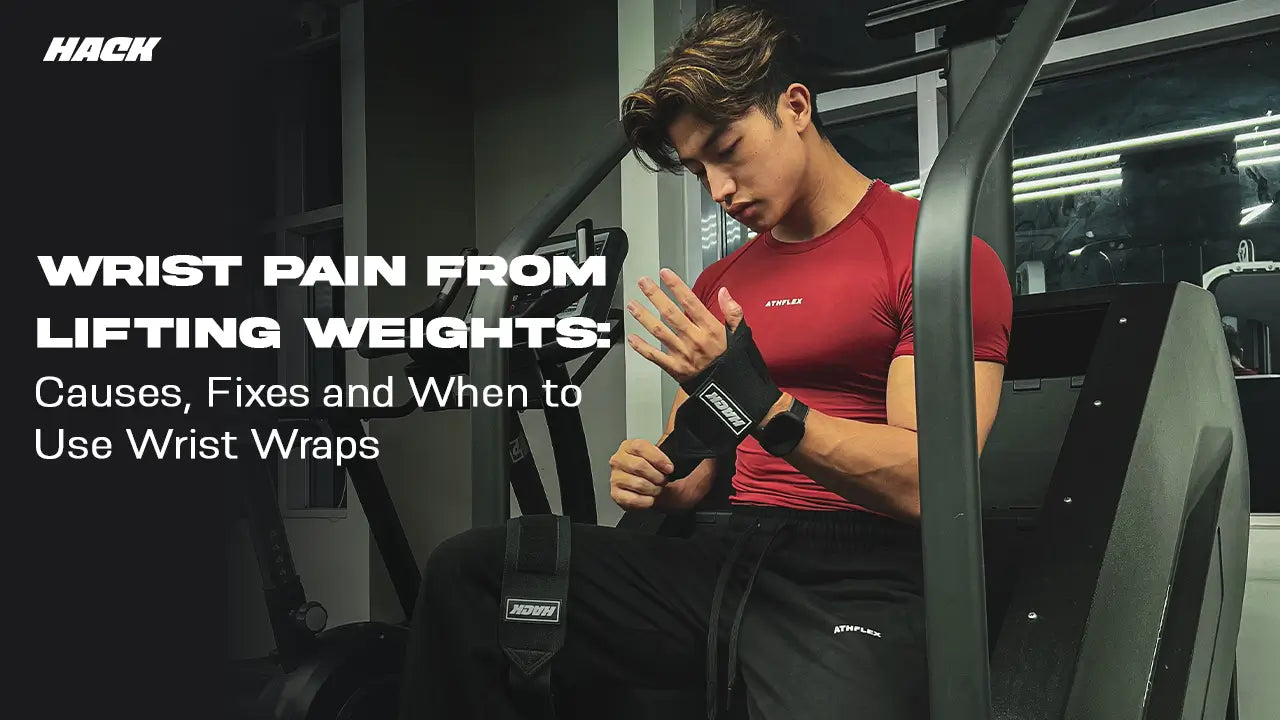
Wrap from the base of the palm toward the forearm, firmly enough to limit extension without cutting off circulation. You should feel resistance the moment your wrist tries to hyperextend under the bar, not constant tightness at rest.
7. Mistakes That Make Wrist Pain Worse
The most common mistake is wrapping every single set, including warm-ups, which can mask an early technique problem instead of forcing you to address it directly.
Lifting through sharp, worsening pain while relying on wraps is one of the fastest ways to turn a minor strain into a more serious tendon injury. Pain that changes character or intensity under load is not something wraps are designed to override.
Another frequent mistake is wrapping too loosely to actually restrict extension, which provides a false sense of support without the mechanical benefit. If you cannot feel the wrap resisting your wrist under load, it is not doing its job.
8. Recovery, Rest and Ongoing Care
For mild strain, reducing the volume or load on the specific movement that triggers pain for one to two weeks, while continuing to train everything else normally, is usually enough. Ice after sessions can help manage inflammation in the short term.
Once pain resolves, reintroduce full loading gradually rather than jumping straight back to your previous working weight. This is also a good window to address any mobility limitation that contributed to the strain in the first place, and to review your overall recovery routine, including hydration, which plays a supporting role in how well connective tissue recovers between sessions. If your training also includes racquet sports that load the wrist differently, such as the growing crossover into pickleball, apply the same principle of listening to early discomfort rather than pushing through it.
Keep a simple training log noting which movements trigger discomfort and at what load. This makes it far easier to identify whether a fix, whether that is bar position, wraps, or reduced volume, is actually working over the following two to three weeks, rather than guessing.
9. When to See a Doctor
See a medical professional if pain persists beyond two to three weeks of reduced loading, if there is visible swelling or bruising, if you experience numbness or tingling in the fingers, or if the pain followed a specific fall or twisting incident rather than gradual onset.
Reference point: Clinical guidance published in American Family Physician on diagnosing wrist pain emphasizes that a proper history and physical examination is the starting point for distinguishing a strain from a more serious ligament or bone injury.
A peer-reviewed clinical approach to diagnosing wrist pain, published in American Family Physician, underscores that an unrecognized fracture, such as a scaphoid fracture, is sometimes mistaken for a mild sprain, which is exactly why persistent pain deserves proper evaluation rather than continued wrapping.
Specific to genuine sprains, OrthoInfo's dedicated guidance on wrist sprains explains that even an injury that looks mild, with minimal swelling, can still involve a torn ligament requiring more than rest to heal properly. This is the core reason lifters should not use wrist wraps as a substitute for a proper diagnosis after any acute, sudden-onset wrist injury, as opposed to gradual training-related discomfort.
10. Who Benefits Most From Wrist Wraps?
Wrist wraps are not a one-size-fits-all product. Different lifters benefit from different levels of support depending on training goal.
- Wrist pain from lifting is usually overuse strain from wrist extension under load, not a single acute injury.
- Bar position correction fixes a large share of chronic bench press wrist pain.
- Wraps limit hyperextension, so they help pressing pain but not grip fatigue or ligament injuries.
- Flexible wraps suit moderate loads, stiff wraps suit near-maximal pressing days.
- Persistent pain, swelling, bruising or numbness need medical evaluation, not more wrapping.
- Mobility work is an underused fix for chronic front rack and overhead wrist discomfort.
- Reintroduce full loading gradually after any period of reduced volume.
11. Related Reading
12. Frequently Asked Questions
What causes wrist pain when lifting weights?
The most common causes are excessive wrist extension under load, particularly during front squats, overhead pressing and heavy barbell curls, along with overuse tendonitis from repetitive pressing and gripping. Less commonly, a fall or a sudden twist under load can cause a genuine ligament sprain, which needs different care than simple overuse pain.
Do wrist wraps actually help wrist pain?
Wrist wraps help by limiting how far the wrist can hyperextend under load, which reduces strain on the tendons crossing the joint during pressing movements. They are most effective for pain caused by wrist extension under load, such as bench press or overhead press discomfort, and less effective for pain caused by grip fatigue or a genuine ligament injury.
Should I choose flexible or stiff wrist wraps?
Flexible wraps, like the Hack Athletics 24 inch Flexible Wrist Support, suit lighter accessory work and lifters who want some mobility retained. Stiff wraps, like the 24 inch Stiff Wrist Support, suit heavy pressing days where you want maximum wrist restriction and minimal give under a near-maximal bar.
How tight should wrist wraps be worn?
Tight enough to firmly limit wrist extension without cutting off circulation or causing numbness in the fingers. A useful check is wrapping to the point where you feel firm support the moment you extend the wrist, then stopping, rather than wrapping as tightly as physically possible.
Can wrist wraps fix a wrist injury?
No. Wrist wraps support and limit motion during lifting, but they do not treat an underlying sprain, tendonitis or fracture. If pain persists after rest, worsens with normal daily use, or includes swelling, bruising or numbness, see a doctor rather than relying on wraps to lift through it.
Why does my wrist hurt specifically during front squats?
Front squats require significant wrist extension to hold the bar in the rack position, which can strain lifters with limited wrist and forearm mobility. Improving thoracic and wrist mobility, or switching to a cross-arm grip temporarily, often resolves this more effectively than wraps alone.
Is it normal for wrists to hurt after heavy bench press?
Mild fatigue is common, but sharp or persistent pain is not something to push through. It usually signals the bar is sitting too low in the palm, causing excess wrist extension. Adjusting bar position higher in the palm and adding wrist wraps for heavy sets typically resolves this.
How long does wrist tendonitis from lifting take to heal?
Mild tendonitis often improves within two to four weeks with reduced loading, technique correction and appropriate rest between sessions. More significant cases can take six to eight weeks or longer, and a lack of improvement within that window is a signal to see a doctor rather than continuing to train through it.
Can beginners wear wrist wraps every session?
Beginners can, but it is worth building baseline wrist and forearm strength on lighter days without wraps first. Relying on wraps for every single set, including warm-ups, can mask early technique issues that are better fixed directly rather than supported around indefinitely.