






- IPF and USA Powerlifting equipment rules require a belt of uniform width, up to 4 inches, and uniform thickness, up to 13mm, so tapered belts cannot be used in sanctioned competition.
- Powerlifting belts (7mm, 10mm and 13mm) are built for maximal bracing on squat, bench and deadlift, while bodybuilding belts are usually tapered and softer for comfort across varied gym movements.
- Belt thickness changes rigidity, not just support: 7mm suits general training and prong-belt beginners, 10mm suits most intermediate to advanced lifters, and 13mm suits lifters chasing near-maximal loads.
- A lever buckle fastens in under two seconds at a fixed hole, while a prong buckle offers finer half-hole sizing adjustments at the cost of speed.
- Correct sizing is based on a belly-button measurement with clothes on, never pant or waist size, since the belt sits above the hips and below the rib cage.
- Wearing a belt increases intra-abdominal pressure against a braced core, which research has linked to reduced spinal compressive load during heavy lifts.
- 1. What Is a Powerlifting Belt vs a Bodybuilding Belt?
- 2. How Belts Actually Support Your Lifts
- 3. Width, Thickness and Buckle: The Full Comparison
- 4. Best Use Cases for Each Belt Type
- 5. Performance Factors That Change the Feel
- 6. How to Choose the Right Belt for You
- 7. Common Mistakes When Buying a Lifting Belt
- 8. Break-In, Care and Maintenance
- 9. Expert Tips for Getting the Most From Your Belt
- 10. Who Uses Powerlifting vs Bodybuilding Belts?
- 11. Related Reading
- 12. Frequently Asked Questions
If you have stood in the weightlifting belts aisle wondering why one belt is uniformly thick all the way around and another tapers to a point at the front, you are not alone. The powerlifting belt vs bodybuilding belt question comes up constantly, and the honest answer is that both are built to solve slightly different problems.
A powerlifting belt is designed around a strict, uniform specification because it has to pass equipment checks at federation events. A bodybuilding belt has no such requirement, so it is designed purely around comfort and range of motion across a bodybuilding split. Before you buy, it helps to understand who Hack Athletics builds these belts for and why the specifications differ, which you can read more about on our about us page.
This guide breaks down the real differences in width, thickness, buckle type and use case, so you leave with a belt that matches how you actually train, not just how it looks on a shelf.
Last reviewed: July 2026
1. What Is a Powerlifting Belt vs a Bodybuilding Belt?
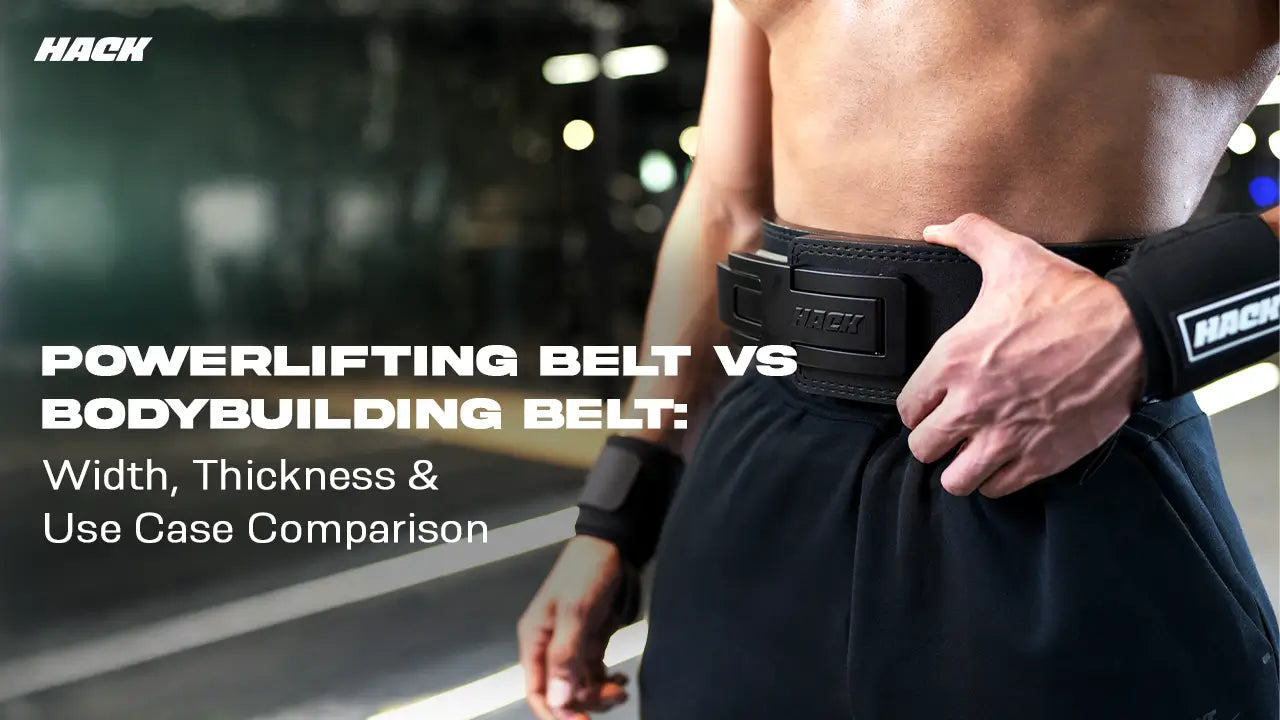
A powerlifting belt is a rigid, uniform-width leather belt built to a strict equipment specification. Federations such as the International Powerlifting Federation require that a competition belt be no wider than 4 inches and no thicker than 13mm, with that width held constant front and back. This uniformity is what lets the belt provide the same bracing surface whether you are in a deep squat, locked out on a deadlift, or arching for a bench press.
A bodybuilding belt, by contrast, is usually tapered, narrower at the front (often 4 inches) and wider at the back (often 6 inches), and made from softer, more pliable material. It is designed to let you fold forward comfortably during movements like seated shoulder press or leaning-forward rows, where a rigid, uniformly wide belt would dig in.
Spec to remember: IPF and USA Powerlifting rules cap belt width at 4 inches and thickness at 13mm, with the belt worn on the outside of the lifting suit or attire.
Why the distinction matters before you buy
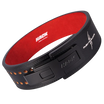
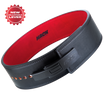
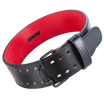
If you plan to compete, or simply want one belt that performs identically in every position, a uniform powerlifting-style belt like the Hack Athletics 13mm Lever Belt is the safer purchase. If your training is exclusively bodybuilding-style accessory work with a lot of seated and forward-leaning movements, a tapered belt may feel more comfortable, though it will not meet competition equipment rules.
2. How Belts Actually Support Your Lifts
A lifting belt does not lift the weight for you. What it does is give your braced core something rigid to push against. When you take a deep breath into your abdomen and brace outward against the belt, you increase intra-abdominal pressure, which acts like an internal air cylinder supporting your spine from the inside.
In practice, lifters report that this bracing sensation is the single biggest difference a belt makes, more than any perceived weight it "adds" to the bar. Research on this mechanism goes back decades: an early controlled study measuring intra-abdominal pressure during weightlifting with and without a belt found that a standard lifting belt measurably increases IAP during heavy lifting, which is theorized to reduce compressive load on the spinal discs.
Belt bracing is a skill, not a switch. Practice taking a 360-degree breath into your belly and sides, not just your chest, before you rely on a belt for a heavy set.
This mechanism is identical whether you are wearing a powerlifting belt or a bodybuilding belt. What changes between the two is how consistently that bracing surface behaves as your torso angle changes through a lift.
3. Width, Thickness and Buckle: The Full Comparison
The table below lines up the two belt styles against the specifications that actually change how a belt performs, drawing on Hack Athletics' 7mm, 10mm and 13mm lever and prong belt range.
| Spec | Powerlifting Belt | Bodybuilding Belt |
|---|---|---|
| Width | Uniform 4 inches, front and back | Often tapered, 4 inches front, 6 inches back |
| Thickness | 7mm, 10mm or 13mm, rigid non-stretch leather | Usually 6-10mm, softer or padded construction |
| Buckle | Lever (fast, fixed hole) or prong (adjustable) | Usually a single or double prong buckle |
| Competition legal | Yes, when on an IPF or federation Approved List | No, tapered belts fail uniform-width rules |
| Best for | Squat, bench, deadlift, near-maximal bracing | Seated presses, rows, general accessory work |
| Break-in time | Longer, especially at 13mm | Shorter, softer materials flex faster |
4. Best Use Cases for Each Belt Type
Choosing between the two styles comes down to what your training actually looks like week to week, not just what looks impressive on the platform.
When a powerlifting belt is the right call
If your main lifts are the squat, bench press and deadlift, and you regularly train within 10 percent of your working max, a uniform belt such as the 10mm Lever Belt Carbon Fibre is the better fit. It gives identical bracing support whether you are in the bottom of a squat or locked out at the top of a deadlift.
When a bodybuilding-style belt makes sense
If your split leans heavily on seated overhead pressing, leg press, or rowing variations that require you to fold forward, a tapered belt reduces the digging sensation a uniform belt can cause in those positions.
Field observation: Most hybrid lifters who both compete and bodybuild end up owning two belts, a uniform lever belt for the big three and a lighter, more flexible belt for accessory days.
5. Performance Factors That Change the Feel
Thickness is the biggest single factor in how rigid a belt feels once broken in. A 7mm belt, like the Hack Athletics 7mm Prong Belt, flexes more readily and suits lifters newer to belted training. A 13mm belt, such as the 13mm Lever Belt Carbon Fiber, holds its shape under maximal loads and gives the firmest bracing surface, at the cost of a longer break-in period and a stiffer initial feel.
Find Your Belt Thickness
Compare 7mm, 10mm and 13mm lever and prong belts side by side and match one to your training level.
Shop Weight Lifting BeltsBuckle style is a secondary but real performance factor. A lever buckle, found on the 13mm Lever Belt and 10mm Lever Belt Signature Red, locks to one exact hole and can be snapped open or shut in under two seconds between sets, which matters during timed competition attempts. A prong buckle, or Hack Athletics' Quick Locking Weightlifting Belt, offers finer half-hole size adjustments, useful if your waist measurement changes across a training cycle or a competition weigh-in.
Check your federation's current Approved List before a competition. Belt approval status can change, and an otherwise legal belt spec can still be rejected if the manufacturer is not on that federation's current list.
6. How to Choose the Right Belt for You
USA Powerlifting generally mirrors IPF equipment specifications for its own sanctioned meets, as outlined in the USA Powerlifting rulebook, so checking both federations' current lists is worthwhile if you compete or plan to cross into equipped divisions later. Work through these questions in order:
- Do you compete, or plan to? If yes, a uniform 4 inch belt at 13mm or less, from an approved manufacturer, is close to mandatory.
- What is your primary training style? Heavy compound lifts favor a uniform belt. Bodybuilding splits with seated and forward-leaning work favor a tapered belt.
- How experienced are you with belted bracing? Newer lifters generally do better starting at 7mm or 10mm rather than jumping straight to 13mm.
- Do you want speed or fine-tuned fit? Choose a lever for speed, a prong for adjustability.
Use the Hack Athletics size chart to confirm your belt size before ordering, since sizing is based on a belly-button measurement, not your regular pant or waist size.
7. Common Mistakes When Buying a Lifting Belt
The most frequent mistake is sizing off pant size instead of a direct belly-button measurement with clothes on, which almost always results in a belt that is too loose to brace against properly.
Buying a tapered bodybuilding-style belt for competition prep is a common and avoidable error. It will not pass equipment check, no matter how well made it is, because it fails the uniform-width requirement.
Other frequent mistakes include buying 13mm as a first belt without building up bracing technique first, and skipping the manufacturer's specific size chart in favor of a generic sizing table, which can differ meaningfully between brands and belt models such as the 13mm Lever Belt size chart versus the Prong Belt size chart.
8. Break-In, Care and Maintenance
Leather lifting belts, particularly at 10mm and 13mm, need a genuine break-in period. Wearing the belt for lighter warm-up sets before your first heavy session helps the leather begin to conform to your torso shape without the discomfort of forcing it under a maximal load on day one.
Store the belt flat, away from direct heat or humidity, and avoid dropping a lever-style buckle repeatedly, since this is one of the few things that can damage the mechanism over time. Wipe the belt down after sweaty sessions rather than letting moisture sit in the leather.
9. Expert Tips for Getting the Most From Your Belt
A common observation among competitive powerlifters is that belt thickness should scale with how close you train to your true one-rep max, not simply how long you have been training. A lifter who trains mostly in moderate rep ranges at 70 to 80 percent of max may never need a 13mm belt at all.
Data point: A peer-reviewed review in the Strength and Conditioning Journal concluded that, while findings on belts are mixed across industrial and athletic contexts, the overall evidence supports selective belt use during near-maximal resistance training, particularly for the squat and deadlift.
For a deeper look at the research on belt use in strength training, the NSCA's Strength and Conditioning Journal review of lifting belt research remains one of the most cited references on the topic, and the National Strength and Conditioning Association continues to publish updated guidance for coaches on belt programming.
10. Who Uses Powerlifting vs Bodybuilding Belts?
Belt choice tends to cluster by training goal rather than experience level alone.
- Powerlifting belts are uniform width and thickness by rule; bodybuilding belts are typically tapered and softer.
- 7mm suits beginners, 10mm suits most lifters, 13mm suits near-maximal competitive training.
- Lever buckles are faster; prong buckles offer finer size adjustment.
- Size using a belly-button measurement with clothes on, never pant size.
- Only uniform-width, federation-approved belts are legal for sanctioned competition.
- Break in a new belt gradually before your first heavy session in it.
- Belt bracing technique matters as much as belt choice itself.
11. Related Reading
12. Frequently Asked Questions
What is the main difference between a powerlifting belt and a bodybuilding belt?
A powerlifting belt is uniformly wide, typically 4 inches front and back, and made from thick, rigid leather so it works the same in every position during a squat, bench or deadlift. A bodybuilding belt is often tapered, narrower at the front and wider at the back, and made from softer, more flexible material for comfort during varied gym movements rather than a fixed competition standard.
Is a 4 inch wide belt too wide for bodybuilding training?
Not necessarily. A 4 inch belt like the Hack Athletics 13mm lever belt gives strong, even bracing for heavy compound lifts such as squats and deadlifts. It can feel bulky during seated or overhead accessory work, which is why many bodybuilders prefer a tapered 4 inch front, 6 inch back design for those specific movements.
Can I use a powerlifting belt for bodybuilding workouts?
Yes. A powerlifting-style lever or prong belt works well for any heavy bracing movement, including bodybuilding leg days built around squats, deadlifts and hip thrusts. It is simply less suited to seated overhead pressing or exercises where you need to bend forward significantly, since the uniform width limits how far you can fold at the hips.
Should a beginner choose a 10mm or 13mm belt?
Most beginners are better served by a 10mm belt. It is easier to break in, more comfortable through a full range of positions and still provides strong bracing support. A 13mm belt is stiffer and best suited to lifters who already brace effectively and are chasing near-maximal squat and deadlift loads.
Are tapered belts allowed in powerlifting competition?
No. Federations including the IPF and USA Powerlifting require a belt of uniform width, not exceeding 4 inches, and a uniform thickness not exceeding 13mm. Tapered bodybuilding-style belts do not meet this specification and will not pass equipment check at a sanctioned meet.
How tight should a lifting belt be?
Tight enough that you can still take a full breath and brace hard against it, but not so tight that it restricts your breathing at rest. A good test is being able to fit two fingers between the belt and your torso before you brace, then feeling the belt press firmly into your midsection once you take a deep breath in.
Do lever belts and prong belts feel different once broken in?
Both use the same thick, non-stretch leather, so the bracing feel is nearly identical once broken in. The difference is fastening speed and fit precision. A lever gives a fixed, one-hole fit you can snap shut in under two seconds, while a prong belt offers finer half-hole adjustments across a wider range.
Can women use the same lever belts and lifting straps as men?
Yes. Belt performance depends on waist measurement and bracing technique, not gender. Hack Athletics belts are sized using a mid-section measurement rather than pant size, so the same 7mm, 10mm and 13mm belts fit both men and women correctly when sized using the size chart.