






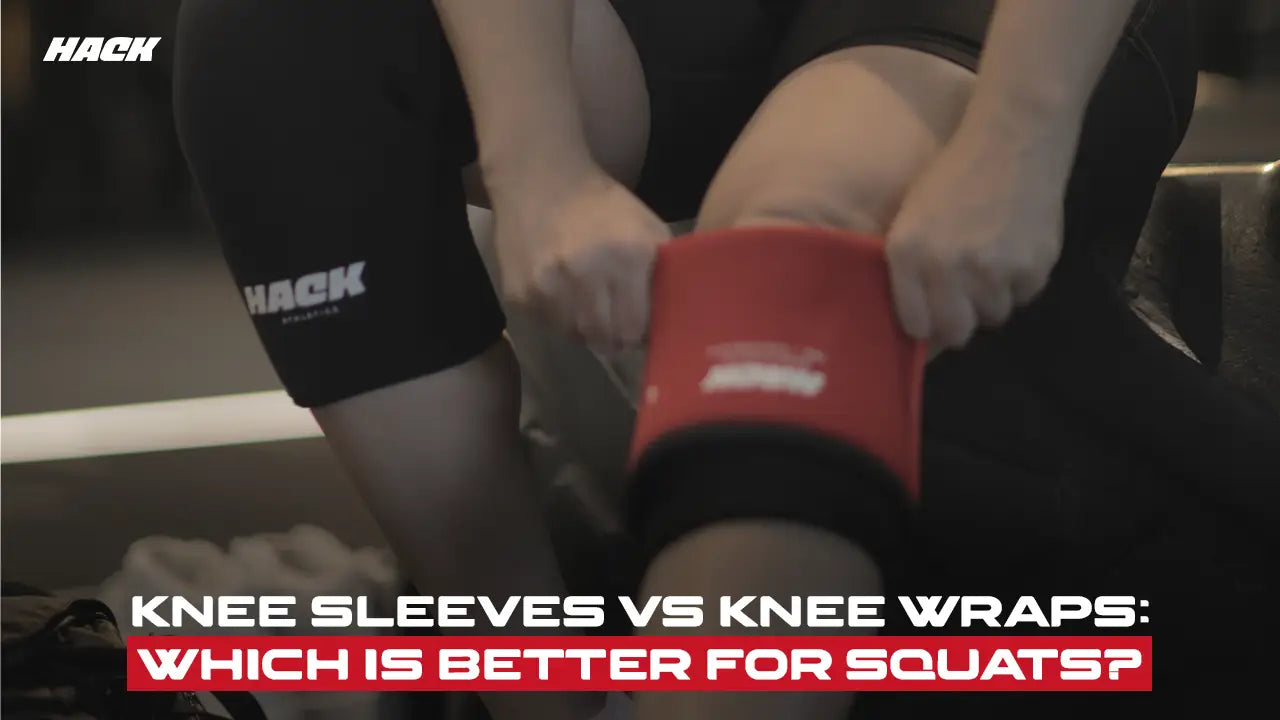
- Knee sleeves are compressive neoprene tubes that provide warmth and stability without actively assisting the lift.
- Knee wraps store and release elastic energy during a squat, which is genuine mechanical assistance, not just support.
- IPF technical rules cap knee sleeve thickness at 7mm and prohibit wearing sleeves and wraps together.
- Wraps are typically restricted to the Equipped division, while sleeves are permitted in raw and Classic competition.
- A recent peer-reviewed study found that knee sleeve density measurably affects force-velocity-power output during the back squat.
- Beginners generally do better starting with sleeves, since wraps require specific wrapping technique to use safely and effectively.
- 1. What Are Knee Sleeves and Knee Wraps?
- 2. How Each One Actually Works on Your Squat
- 3. Specifications and Rules, Compared
- 4. Best Use Cases for Sleeves vs Wraps
- 5. Thickness, Density and Fit
- 6. How to Choose the Right Knee Support
- 7. Common Mistakes With Knee Support Gear
- 8. Putting On, Removing and Caring for Sleeves
- 9. Expert Tips on Knee Support Selection
- 10. Who Uses Knee Sleeves vs Knee Wraps?
- 11. Related Reading
- 12. Frequently Asked Questions
The knee sleeves vs knee wraps question trips up a lot of lifters, mostly because the two products look similar at a glance but do genuinely different jobs. Both sit in the same part of the knee support category, but only one of them actively changes how much weight you can move.
Hack Athletics builds squat and bracing gear for lifters who train seriously, and understanding that distinction matters before you spend money on the wrong product for your goals. You can read more about our approach on the about us page.
This guide breaks down exactly how each product works, what competition rules say, and which one actually fits your training style, so you can spend on the right gear the first time instead of discovering the mismatch on meet day or mid-workout.
Last reviewed: July 2026
1. What Are Knee Sleeves and Knee Wraps?
Knee sleeves are compressive neoprene tubes worn over the knee joint. They provide warmth, mild compression and proprioceptive feedback, meaning they help you feel where your knee is in space during a lift, but they do not actively push the bar back up for you.
Knee wraps are long, elastic bandages wound tightly around the knee before a lift. Under compression, the wrap material stores elastic energy on the way down into a squat and releases that energy on the way up, functioning similarly to a compressed spring assisting the ascent.
Core distinction: Sleeves support. Wraps assist. That single difference explains almost every rule difference between the two in competition.
Why this distinction shapes federation rules
Because wraps genuinely change how much weight a lifter can move, federations including the International Powerlifting Federation treat wraps as equipment specific to the Equipped division, while sleeves, which do not provide the same mechanical assistance, are permitted in raw and Classic competition.
2. How Each One Actually Works on Your Squat
A knee sleeve works primarily through compression and warmth. Keeping the joint and surrounding tendons warm is widely reported by lifters to reduce the stiff, achy feeling that comes from repeated heavy knee flexion, and the mild compression gives extra proprioceptive feedback about knee position through the descent.
Compression from a sleeve is a support mechanism, not a strength mechanism. It will not add pounds to your squat the way a wrap can.
A knee wrap works through elastic energy storage. As you descend into the squat, the wrap material stretches and stores energy. On the ascent, that stored energy releases and assists the upward drive, similar in principle to how a compressed spring returns energy. This mechanical assistance is well documented in biomechanics research comparing wrapped and unwrapped squat conditions, which found measurable differences in muscle force contribution when wraps were worn.
It is worth being precise about what "assistance" means here, since it is often misunderstood. A wrap does not make you technically stronger; it does not build muscle or improve your neuromuscular efficiency the way progressive training does. What it does is temporarily change the mechanics of the lift itself, borrowing stored elastic energy to help drive the bar up out of the hole. That is a meaningfully different effect from a sleeve, which changes nothing about the mechanics of the lift and instead supports the joint through the same range of motion you would move through unassisted.
3. Specifications and Rules, Compared
The table below lines up the core specifications and competition status of each product, drawing on current IPF and USA Powerlifting technical rules.
| Spec | Knee Sleeves | Knee Wraps |
|---|---|---|
| Material | Single-ply neoprene | Elastic woven bandage material |
| Max thickness (IPF) | 7mm | Not thickness-limited, length-limited instead |
| Length limit | Not applicable, fixed tube shape | Roughly 2 meters, federation dependent |
| Mechanical assist | None, compression and warmth only | Yes, stores and releases elastic energy |
| Competition division | Raw, Classic and Equipped | Equipped only, in most federations |
| Can be combined | No, cannot be worn with wraps | No, cannot be worn with sleeves |
4. Best Use Cases for Sleeves vs Wraps
If you compete or train in a raw, Classic, or general strength context, knee sleeves such as the Hack Athletics Performance 7mm Knee Sleeves are almost always the correct choice, since they are legal across every major division and provide genuine comfort and stability benefits.
When knee wraps make sense
Knee wraps are appropriate specifically for lifters training or competing in an Equipped division, where the goal is maximal load on the bar and the mechanical assistance of a wrap is part of the intended training stimulus. Outside of that context, most raw lifters have little practical use for wraps.
Practical note: If you are unsure which division you compete in, you almost certainly want knee sleeves, not wraps, since Classic and raw divisions make up the large majority of modern powerlifting participation.
Cross-training and general gym use
Outside of dedicated powerlifting, many lifters wear sleeves for general leg day support, including squats, lunges and leg press, simply for the comfort and joint warmth benefit. This is a different use case entirely from competition prep, and it is one reason Hack Athletics sizes and sells sleeves alongside broader gym equipment, not just federation-specific gear.
5. Thickness, Density and Fit
Thickness and density directly change how a sleeve performs. A recent peer-reviewed study on knee sleeve density and its effect on the force-velocity-power profile during the back squat found that sleeve density measurably influenced theoretical strength output, reinforcing that sleeve choice is not purely a comfort decision.
Find Your Knee Sleeve Fit
Compare 7mm cone and hourglass profile knee sleeves and size them correctly using our detailed charts.
Shop Knee SupportThe Hack Athletics 7mm Performance Knee Sleeves 2.0 use a 7mm neoprene build at the maximum thickness permitted under IPF rules, giving firm compression for lifters training close to their working max. Sizing is based on a direct knee circumference measurement, not shoe size or overall height, so check the appropriate chart, whether that is our cone profile size chart or hourglass profile size chart, before ordering.
Cone and hourglass sleeve profiles fit differently even at the same stated thickness. Always check the profile-specific chart rather than a generic size table.
6. How to Choose the Right Knee Support
Work through these questions:
- What division do you train or compete in? Raw or Classic: sleeves. Equipped: wraps.
- Is your goal comfort and joint warmth, or maximal load assistance? Sleeves for the former, wraps for the latter.
- How experienced are you with squat mechanics? Beginners should build technique with sleeves before considering wraps.
- Do you have any existing knee discomfort? Sleeves are the more common choice for general comfort, though persistent pain deserves a doctor's evaluation rather than gear alone.
It is also worth budgeting for two sleeve thicknesses if your training genuinely spans both heavy competition-style work and higher-volume accessory days. A 7mm sleeve can feel restrictive for high-rep leg work, where a lighter 5mm option or no sleeve at all may suit better, while heavy singles and doubles are exactly where 7mm compression earns its keep.
7. Common Mistakes With Knee Support Gear
The most common mistake is buying knee wraps for raw or Classic training, where they are not competition legal and provide little benefit outside a wrapping-specific technique context.
Sizing knee sleeves off general height or shoe size, rather than an actual knee circumference measurement, is a common ordering mistake that leads to sleeves that are too loose to provide meaningful compression.
Another frequent mistake is wearing sleeves so tight they cause numbness in the lower leg during a set, which is a sign to size up rather than push through the discomfort.
8. Putting On, Removing and Caring for Sleeves
Neoprene knee sleeves are genuinely difficult to put on and take off due to their compressive fit, and 2026 IPF rule updates now explicitly permit lifters to receive assistance putting sleeves on before a competition attempt, recognizing how physically demanding this can be before a heavy set.
Rinse sleeves with water after sweaty sessions and let them air dry away from direct heat, which extends the neoprene's compressive lifespan considerably compared to letting sweat sit in the material between sessions. Avoid folding sleeves sharply along one crease repeatedly, since this can weaken the neoprene at that fold line over months of use.
If you also use a weightlifting belt for the same squat sessions, put the belt on after the sleeves so you can properly brace and check your setup before adding the final piece of gear.
9. Expert Tips on Knee Support Selection
A common observation among coaches is that lifters often reach for knee wraps hoping to fix knee pain, when in most cases a sleeve, combined with addressing squat depth and bar path issues, resolves the underlying discomfort more effectively.
Clinical note: A peer-reviewed review of bracing and splinting for common musculoskeletal conditions found that supportive bracing can aid comfort and function for certain joint conditions, but is not a substitute for addressing the underlying cause of persistent pain.
For broader context on knee bracing outside of sport, the American Academy of Orthopaedic Surgeons' guidance on knee arthritis outlines how support versus unloader-style bracing serves different clinical goals, and a peer-reviewed overview of braces and splints for common musculoskeletal conditions in American Family Physician offers useful general context on when bracing genuinely helps recovery.
On the competitive side, the USA Powerlifting rulebook largely mirrors IPF specifications on knee sleeves and wraps, which is useful to confirm if you compete domestically before qualifying for international competition under IPF rules.
10. Who Uses Knee Sleeves vs Knee Wraps?
Product choice tends to track training division closely.
- Sleeves support and warm the joint; wraps actively assist the lift through stored elastic energy.
- IPF rules cap sleeve thickness at 7mm and forbid combining sleeves with wraps.
- Wraps are generally Equipped-division only; sleeves are legal across raw, Classic and Equipped.
- Sleeve density and thickness meaningfully affect force output, not just comfort.
- Always size using knee circumference and the correct profile chart, cone or hourglass.
- Beginners should build squat technique with sleeves before considering wraps.
- Persistent knee pain needs medical evaluation, not just supportive gear.
11. Related Reading
12. Frequently Asked Questions
What is the main difference between knee sleeves and knee wraps?
Knee sleeves are neoprene tubes that provide compression, joint warmth and mild stability, without actively adding force to your lift. Knee wraps are elastic bandages wound tightly around the knee that store and release energy during a squat, actively assisting the lift, which is why the two are treated very differently under competition rules.
Do knee wraps actually add weight to your squat?
Yes. Tightly wound knee wraps store elastic energy on the way down and release it on the way up, similar to a compressed spring, which can add meaningfully to the weight a lifter can move. This is precisely why wraps are restricted to the Equipped division in most federations rather than allowed in raw or Classic competition.
Can I wear knee sleeves and knee wraps together?
No. IPF technical rules explicitly prohibit combining knee sleeves and knee wraps in the same lift, and most other federations follow the same restriction. You must choose one or the other based on which division you are competing in.
What thickness of knee sleeve should I choose?
7mm neoprene is the standard thickness for most powerlifting-style knee sleeves, like the Hack Athletics Performance 7mm Knee Sleeves, and is the maximum thickness permitted under IPF rules. Thinner sleeves around 5mm offer more mobility and less compression, which some lifters prefer for general training or if 7mm feels overly restrictive.
Are knee sleeves allowed in raw or Classic powerlifting?
Yes. Knee sleeves are permitted in Classic and raw divisions across most federations, including the IPF, because they do not actively assist the lift the way wraps do. Knee wraps, by contrast, are typically restricted to the Equipped division.
Do knee sleeves help with knee pain during squats?
Many lifters report improved comfort and joint warmth from wearing knee sleeves, which some find helpful for managing minor tendon irritation. Sleeves are not a medical treatment, and persistent or sharp knee pain should be evaluated by a doctor rather than managed with a sleeve alone.
How tight should knee sleeves fit?
Knee sleeves should fit snugly enough to stay in place through a full squat without sliding, but not so tight that they cause numbness or restrict circulation. Many lifters size down slightly from their measured knee circumference for a firmer, more supportive fit, based on the manufacturer's specific size chart.
Can beginners use knee wraps?
Beginners are generally better served starting with knee sleeves rather than wraps. Wraps require a specific wrapping technique and add real assistance to the lift, which can mask technique issues that are better addressed directly while a lifter is still building squat mechanics.