






- 7mm neoprene is the standard thickness for serious powerlifters competing under IPF, USAPL, and PFI rules, with 5mm reserved for CrossFit and general training.
- Cone-shaped sleeves suit the majority of lifters, while hourglass sleeves give experienced competitors more rebound out of the hole.
- Correct sizing follows knee circumference at the centre of the patella measured with a slightly bent leg, not thigh or calf measurements.
- Sleeves provide three measurable benefits: joint warmth, proprioceptive feedback, and a small amount of elastic rebound. They are not orthopaedic braces.
- Quality 7mm sleeves last 18 to 24 months with regular use before compression softens. Hand washing in cold water doubles their lifespan.
- Indian competitive powerlifters under the Powerlifting Federation of India (PFI) and World Powerlifting Congress India follow IPF equipment rules for raw category lifts.
- What Knee Sleeves Actually Do in a Powerlifting Squat
- How Compression and Heat Retention Translate to Performance
- Thickness, Shape, and Construction Compared
- Who Should Use Powerlifting Knee Sleeves
- Material Quality, Stitching, and What Lasts
- How to Choose the Right Knee Sleeves
- Common Mistakes Indian Lifters Make Buying Knee Sleeves
- Care, Washing, and Storage
- Advanced Tips from Competitive Lifters
- Who Uses Powerlifting Knee Sleeves
- Related Reading
- Frequently Asked Questions
Walk into any serious gym in Mumbai, Bengaluru, or Delhi on a heavy squat day and you will see them: snug black neoprene tubes covering knees from mid-calf to mid-thigh. Knee sleeves are the most quietly important piece of supportive gear a powerlifter owns. They are not flashy, they are not heavily marketed, and yet the lifter who skips them often spends the first three working sets warming up the joint that a sleeve would have warmed in two minutes. This guide is for Indian lifters who want to choose the right pair without wasting money on imports that take six weeks to arrive or generic gym-store models that lose their compression in three months. We will cover thickness, shape, fit, federation legality, care, and the trade-offs that matter once the squat gets heavy. For background on the full kit a competitive lifter needs, the Hack Athletics gym equipment collection covers belts, straps, and wrist support that pair with sleeves.
Hack Athletics has been building lifting gear specifically for Indian conditions and Indian body proportions since 2023, working with raw competitors training in Mumbai's humid summers and Delhi's dry winters. Sizing charts, neoprene density, and stitching tolerances were tuned through repeated rounds of athlete feedback. The brand's company story and values explain why the equipment is designed to outlast the warranty rather than meet it. If you are coming from imported sleeves and unsure how Indian sizing translates, the master size chart is the reference document used in this guide.
Last reviewed: May 2026
1. What Knee Sleeves Actually Do in a Powerlifting Squat
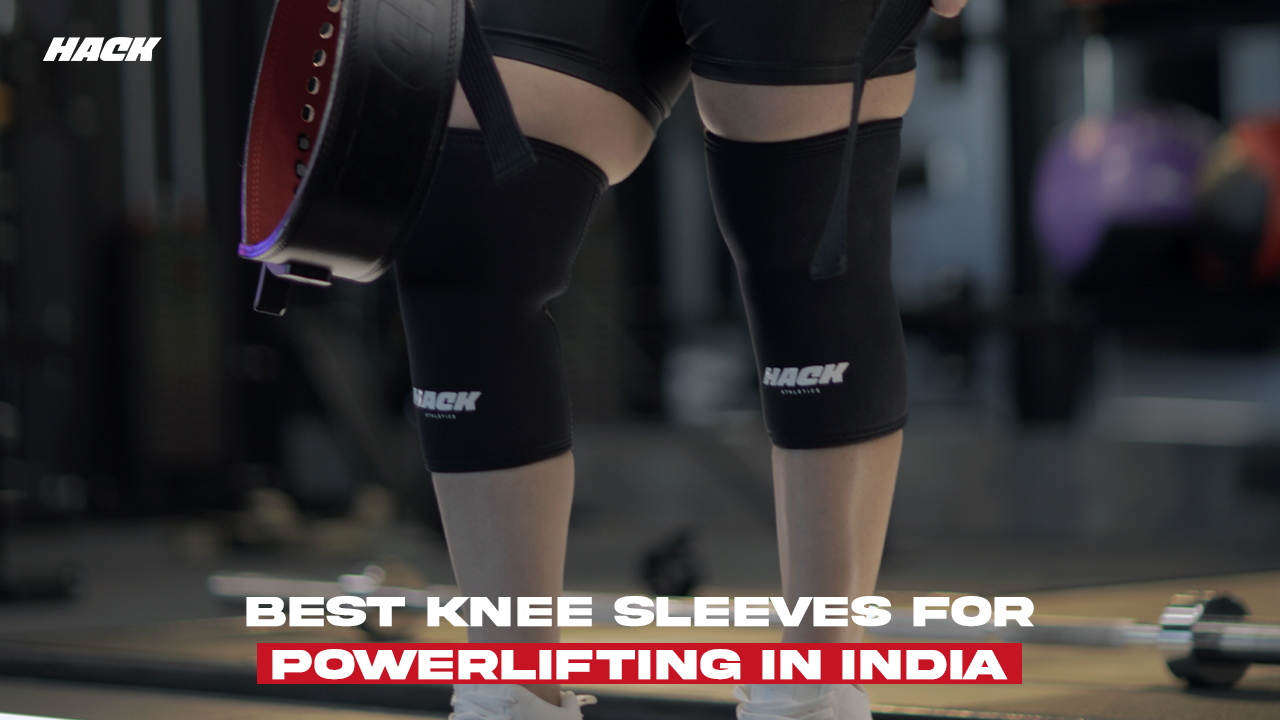
A powerlifting knee sleeve is a length of closed-cell neoprene foam, usually between 25 cm and 30 cm long, that compresses the soft tissue around the knee joint and traps body heat against the patella, quadriceps tendon, and the surrounding ligaments. It is not a brace. It does not stop the joint from moving in any direction. It does not replace strength in the surrounding musculature. What it does is meaningful but specific: it warms the joint, gives the lifter a continuous compressive signal telling the brain where the knee is in space, and stores a small fraction of energy that returns at the bottom of a deep squat.
The mechanical contribution
The elastic rebound is real but smaller than first-time users expect. Independent strength research published by the National Library of Medicine on knee sleeve assistance in resistance exercise consistently shows measurable but modest contributions to peak force in the concentric phase of a maximum squat. Reviews of joint compression and proprioception research from the American College of Sports Medicine support similar conclusions for resistance training contexts. The contribution is large enough that lifters notice it on a one-rep max attempt and small enough that nobody is gaming a meet by switching from 5mm to 7mm.
The proprioceptive contribution
The compression around the knee is more useful than the rebound for most lifters. Proprioception is the body's awareness of joint position, and a constant pressure signal from a 7mm sleeve gives the central nervous system a clearer read on where the knee is during heavy work. Lifters with a tendency to let the knees cave inward on the way up often report tracking improvements within the first few sessions of using sleeves consistently.
Industry data point: Surveys of competitive raw powerlifters published in coaching literature show that more than 85 percent of athletes lifting in IPF-affiliated meets wear knee sleeves on their working sets, with 7mm being the most common thickness chosen.
2. How Compression and Heat Retention Translate to Performance
The most underrated benefit of a knee sleeve is the heat it traps. Cartilage in the knee has a poor direct blood supply and warms up slowly compared to muscle tissue. A cold knee feels stiff and produces a vague unease in the bottom position of a squat that even experienced lifters often misread as a strength issue. Two minutes of warmup with sleeves on does more for joint readiness than five minutes of empty-bar squats without them.
Why this matters more in Indian gyms
Air-conditioned gyms in metro cities run cold by athletic standards, often dropping to 18 to 20 degrees Celsius. Joint stiffness in cold rooms is the most common reason lifters report needing endless warmup sets. Sleeves solve this without changing the workout. Outside the cold-room context, monsoon-season humidity in coastal cities creates a different problem: sweat saturates cheaper foam and degrades it rapidly. This is the single biggest reason to buy from a brand engineering for the Indian climate rather than importing a US-made sleeve that was designed for desert-dry conditions.
Put your sleeves on during the first warmup set with the empty bar and leave them on through the working sets. Pulling them on cold and immediately squatting heavy defeats half the point.
3. Thickness, Shape, and Construction Compared
The three variables that define a powerlifting knee sleeve are thickness, taper shape, and stitching construction. Get these three right and you have the right sleeve for your training. Get them wrong and even a premium brand will feel mediocre.
| Specification | 5mm Sleeve | 7mm Cone | 7mm Hourglass |
|---|---|---|---|
| Best for | CrossFit, general training, warmups | Raw powerlifting, most lifters | Competitive raw lifters wanting maximum rebound |
| Compression level | Moderate | High | Very high at the patella |
| Rebound contribution | Minimal | Noticeable on heavy singles | Most aggressive of the three |
| Ease of putting on | Very easy | Moderate, requires technique | Difficult, demands a specific method |
| IPF and PFI legal | Yes | Yes | Yes if from an approved brand |
| Typical lifespan with regular use | 12 to 18 months | 18 to 24 months | 18 to 24 months |
Stitching matters more than people think
Double or triple-row stitching with bartack reinforcement at the ends of the sleeve carries the load when the neoprene stretches across a working set. Single-row stitching is the most common failure point on cheap sleeves. Pull a new sleeve inside out at the seam and look at the thread density before you buy. The 7mm competition cone-shaped sleeves use reinforced multi-row stitching specifically to handle repeated tight cycling.
4. Who Should Use Powerlifting Knee Sleeves
Not every lifter needs 7mm sleeves, and not every athlete should be wearing sleeves on every set. The decision should be based on the type of training, the loading you actually do, and whether you compete.
Raw competitive powerlifters
If you compete or plan to compete, buy 7mm sleeves that are approved by your federation. In India that means checking the International Powerlifting Federation approved list, since the Powerlifting Federation of India follows IPF technical rules. Hack Athletics knee support collection is built around the dimensions and density requirements set by the IPF rulebook.
Strength athletes and intermediate lifters
If you regularly squat above 1.5 times bodyweight, sleeves are worth the cost. Below that threshold, the marginal benefit is smaller and many lifters get equal value from 5mm sleeves used selectively on heavy sets only.
CrossFit, functional fitness, and general gym work
Choose 5mm sleeves for these contexts. The lower thickness allows full knee flexion in wall balls, box jumps, and the high rep schemes typical of metcons, where 7mm sleeves become uncomfortable. The compression is still enough to retain joint warmth.
Practical threshold: A working squat at 140 kg or above is the point where most lifters report meaningful benefit from upgrading to 7mm sleeves. Below that, 5mm or even high-quality elastic sleeves are sufficient.
5. Material Quality, Stitching, and What Lasts
The biggest performance difference between budget and premium sleeves is not visible in the first week of use. It shows up at the six month mark, when budget sleeves start to feel softer on the working sets and the lifter assumes their squat got stronger. The neoprene foam has actually compressed permanently. Premium closed-cell neoprene retains its rebound properties three to four times longer than open-cell or low-density foam.
What density and construction to look for
The density of the foam, the lining of the inner sleeve, and the quality of the stitching all matter. Look for a sleeve that has a clear interior fabric lining (usually nylon or polyester blend) bonded to the neoprene. Sleeves with exposed neoprene against the skin trap sweat, smell faster, and degrade quickly in humid climates. The hourglass 7mm competition sleeves use a denser neoprene grade in the patella region than in the calf region, which is why the rebound feel is more aggressive.
Closed-cell neoprene is the industry standard for serious knee sleeves. Open-cell or hybrid foams found in budget sleeves feel softer at first but lose compression within months. Always check the product specification before buying.
Train heavier with knees that feel ready from set one
Hack Athletics 7mm competition knee sleeves are designed for Indian raw powerlifters. IPF-spec neoprene, reinforced stitching, and a sizing chart calibrated to Indian leg proportions.
Shop Knee Support Collection6. How to Choose the Right Knee Sleeves
Choosing knee sleeves comes down to four questions answered in order: what are you using them for, what thickness fits that use, what shape suits your knee, and what size matches your measurement. Skipping any of these creates a fitting problem that even the best sleeve cannot solve.
Step one: define the use case
Competition and heavy raw powerlifting calls for 7mm. General strength training, CrossFit, and rehab use calls for 5mm. Mixed training where one or two days per week involve heavy squats and the rest is general work is the most common Indian gym profile. Most lifters in this category should still buy 7mm because the heavy days are where the sleeves earn their cost.
Step two: pick the shape
For most lifters, cone-shaped sleeves are the right starting point. The natural taper of the cone shape fits the geometry of the quadriceps as it descends to the knee and is more forgiving of slight measurement errors. Hourglass sleeves should be reserved for lifters who already know they prefer aggressive rebound and have squatted in cone sleeves for at least six months.
Step three: measure correctly
Measure the circumference of your knee at the centre of the patella, with the leg slightly bent (around 20 to 30 degrees of flexion). A fully straight leg gives a smaller reading and leads to undersizing. The detailed 7mm knee sleeves size chart shows the exact measurement points and conversion ranges.
Step four: match the chart
Match your measurement to the chart and choose the size that lands at the upper end of the range for training, or the exact measurement for competition tightness. For the hourglass version, refer to the specific hourglass-shape knee sleeve size chart since the contour differs from the cone version.
7. Common Mistakes Indian Lifters Make Buying Knee Sleeves
After years of working with raw lifters across Mumbai, Pune, and Bengaluru, the same buying mistakes show up repeatedly. Avoiding them saves money and prevents the frustrating experience of training in gear that does not fit.
Sizing down for tightness
The most common mistake is intentionally choosing a sleeve one size smaller than the chart suggests, in pursuit of a tighter feel. The result is sleeves that are painful to put on, restrict blood flow during long warmups, and leave aggressive welts that take hours to fade. A correctly sized 7mm sleeve is already very tight. Sizing down does not improve performance, it just makes the gear unpleasant to wear.
Buying based on price alone
Cheap sleeves below the 1,500 to 2,000 rupee mark almost always use lower-density foam that softens within six months. The cost-per-month of a premium sleeve that lasts two years is often lower than that of a budget sleeve replaced every eight months.
Ignoring federation rules
Lifters planning their first meet often discover at weigh-in that their generic sleeves are not on the federation approved list. For IPF and PFI competitors, check the equipment list before buying. Budget for an extra week of break-in time before the meet.
Never wear knee sleeves with visible cracks in the neoprene, fraying at the seams, or loose stitching. A sleeve that fails mid-squat under a heavy load can shift unpredictably and pose a real risk. Replace damaged sleeves immediately.
8. Care, Washing, and Storage
Knee sleeves last roughly twice as long with proper care, and the care routine is simple enough that there is no reason to skip it. The two enemies of neoprene are heat and trapped moisture. Manage both and the foam structure stays intact.
Washing routine
After every two or three sessions, hand wash the sleeves in cold water with a small amount of mild detergent. Turn them inside out, work the soap gently into the inner lining, rinse thoroughly, and squeeze the water out without wringing. Hang them inside-out to dry, away from direct sunlight and far from any heat source. A standing fan speeds the process. Never use a washing machine, hot water, or a tumble dryer.
Between-session storage
Store sleeves flat or loosely rolled in a ventilated section of your gym bag, not stuffed at the bottom under wet clothes. If your gym bag stays in a hot car for hours after training, the cumulative heat exposure dramatically shortens sleeve life. The Hack Athletics 30L duffle gym bag has a dedicated ventilated compartment that keeps wet gear separated from clean gear.
End-of-life signs
A sleeve has reached the end of its useful life when, after a full working set, the skin no longer shows a clear pressure imprint, the seam is fraying visibly, or the compression around the calf feels noticeably looser than around the thigh. At that point the foam has lost its structure and the sleeve no longer provides meaningful support.
9. Advanced Tips from Competitive Lifters
Beyond the basics of fit and care, there are habits that experienced raw competitors develop over years of using sleeves in meets and training. These are the small things that make a noticeable difference once the squat is heavy.
Sleeve rotation
If you train more than four days a week with sleeves, owning two pairs and rotating them between sessions extends the lifespan of both. Neoprene needs 24 to 36 hours to fully decompress and dry between uses. A sleeve that goes back into the bag still damp from yesterday accumulates microbial growth far faster.
Donning technique
The right way to put on a 7mm sleeve is to roll the top down onto itself before stepping in, slide the rolled bundle up over the calf, and then flip the rolled top up over the knee with a single sharp motion. Trying to pull the sleeve up like a sock is the most common cause of stretched neoprene and torn seams.
The competition warmup approach
At a meet, put your sleeves on in the warmup room before your second or third warmup set. Leaving them on through your third attempt is standard. According to USA Powerlifting coaching documentation, regulating joint warmth across the entire warmup-to-attempt window is one of the most consistent contributors to attempt success on heavy singles. Resources from the National Strength and Conditioning Association reinforce the same principle for general resistance training contexts.
Time-on-joint principle: Competitive lifters report best results when sleeves are on for at least 8 to 12 minutes before the first heavy attempt, allowing the joint capsule to fully warm to working temperature.
10. Who Uses Powerlifting Knee Sleeves
Knee sleeves are used by a wider range of athletes than most casual lifters realise, and the gear choices vary meaningfully by sport and use case. Understanding where you fit in this landscape makes the buying decision clearer.
- IPF, PFI, and World Powerlifting Congress India raw lifters
- USAPL and IPL competitors
- Strongman and odd-object athletes during deep squat training
- CrossFit Games hopefuls in qualifier season
- For competitive raw powerlifting in India, 7mm IPF-spec sleeves are the standard. 5mm is reserved for general training and CrossFit.
- Cone-shape suits the majority of lifters. Hourglass is for experienced competitors who specifically want aggressive rebound.
- Measure at the centre of the patella with a slightly bent leg. Never size down beyond the chart in pursuit of tightness.
- Hand wash in cold water every two to three sessions, air dry away from heat and sun, and rotate two pairs if training more than four days a week.
- Premium 7mm sleeves last 18 to 24 months. Budget sleeves often need replacement within 8 to 12 months despite a lower sticker price.
- Always confirm federation approval if competing. IPF and PFI competitors should check the approved equipment list before buying.
11. Related Reading
12. Frequently Asked Questions
Are 7mm knee sleeves legal in IPF powerlifting competitions?
Yes. The IPF technical rulebook permits knee sleeves up to 30 cm long made from neoprene with a maximum thickness in the approved range. Both 5mm and 7mm sleeves can be IPF-approved if the brand is on the federation's approved list. Hack Athletics 7mm sleeves meet the construction and thickness specifications required for IPF and most affiliated national federations including PFI in India.
Should I size up or down for powerlifting knee sleeves?
Size based on your knee circumference measured at the centre of the kneecap with a slightly flexed leg. For competition-style tightness, choose the size that matches your measurement exactly or sits at the smaller end of the range. For training and rehab use, picking the upper end of the range or sizing up by one gives easier entry and less compression. Sizing down beyond the chart causes blood pooling and skin damage.
What is the difference between cone-shaped and hourglass knee sleeves?
Cone-shaped sleeves are wider at the top and taper down, mimicking the natural shape of the quadriceps. Hourglass sleeves are narrower at the centre and flare at both the top and bottom, gripping the patella region more aggressively. Cone fits are easier to put on and suit most lifters. Hourglass fits give more rebound out of the bottom of a squat for advanced competitors who prioritise that snap.
How do I wash neoprene knee sleeves so they do not smell?
Hand wash sleeves in cold water with a mild detergent after every two to three sessions. Turn them inside out, scrub the inner lining gently, rinse thoroughly, and hang them to air dry away from direct sunlight. Never put neoprene in a tumble dryer or wash with hot water as heat breaks down the foam structure. Stuffing newspaper inside between sessions absorbs residual moisture.
Do I need knee sleeves if I do not have knee pain?
Knee sleeves are not strictly required, but they offer benefits beyond pain management. They retain heat in the joint capsule which helps the knee feel more responsive during heavy work, provide a modest amount of elastic rebound in deep squat positions, and give proprioceptive feedback that helps many lifters track their knees better. Most competitive powerlifters use them for performance, not pain.
Can I use the same knee sleeves for squats and deadlifts?
Yes you can wear knee sleeves for deadlifts, but most lifters take them off or roll them down. Sleeves at the knee can interfere with the bar path on conventional deadlifts and add unnecessary heat retention since the deadlift does not load the knee in deep flexion. For sumo pullers, leaving them on at the calf is common. They are most valuable on squats and front squats.
How long do good powerlifting knee sleeves last?
Quality 7mm neoprene sleeves used three to four times per week typically last 18 to 24 months before the compression noticeably softens. Heavy raw squatters who use them on every working set may see a noticeable drop in tightness after 12 to 15 months. Stitching usually outlasts the foam. Replacement is recommended when the sleeve no longer leaves a tight imprint on the skin after a working set.
Are knee sleeves the same as knee wraps?
No. Knee sleeves are pull-on neoprene tubes that provide consistent compression and warmth. Knee wraps are long elastic bandages wound tightly around the joint to store elastic energy and add significant weight to a squat. Wraps are used in equipped powerlifting and certain raw federations that permit them. Sleeves are universally allowed and far easier to live with. Most lifters should start with sleeves.
Why do my new knee sleeves hurt to put on?
Brand new 7mm sleeves are intentionally tight and require a specific donning technique. Roll the top of the sleeve down onto itself before stepping in, work it up the calf slowly, then flip the rolled portion up over the knee. The first ten to fifteen wears stretch the neoprene to the shape of your leg. If they remain painful to put on after two weeks of use, you likely sized down too aggressively.